
Shoei GT-Air 3 vs Schuberth C5: Which Is Better for Street Riding?
 Evan Rally
left for contents
Two premium helmets from two legendary brands, built for completely different philosophies. The Shoei GT-Air 3 is a full-face touring lid. The Schuberth C5 is a flip-up modular. Both cost roughly the same, both target the rider who logs long street miles, and both carry the latest safety certifications available in their respective markets. For a Schuberth-focused matchup against a much cheaper flip-up, our Schuberth C5 vs HJC C91 comparison covers what the C5’s premium actually buys.
So how do you decide? That depends on whether you value the flip-up convenience of a modular or the lighter weight and structural simplicity of a full-face. Let’s break it down.
Buy the Shoei GT-Air 3 if you:
- Want a lighter helmet (3.78 lb vs 3.8 lb) with a compact, aerodynamic shell that stays rock-solid at highway speeds
- Prefer a dedicated full-face design with a 5-star SHARP safety rating and Shoei’s hand-built Japanese quality
- Ride sport-touring or naked bikes and don’t need to flip up a chin bar at gas stops

Shoei GT-Air 3 Full Face Motorcycle Helmet
A premium touring helmet built to disappear on long rides: plush liner, adjustable vents, thick neck-roll and tight sealing visor for that sweet sweet silence and an optically-clear drop down sun shield. Fits the SRL3 Sena comms system seamlessly.
- Super quiet
- Wind tunnel molded for smoother ride (less fatigue)
- Eyeglass compatible
- Internal sun shade and Pinlock visor
- A bit heavier than carbon‑shell alternatives
- Ratchet strap may irritate throat
Buy the Schuberth C5 if you:
- Need a modular helmet so you can flip the chin bar up for fuel stops, quick drinks, or chatting without removing your lid
- Want one of the quietest helmets on the market (independent tests measure ~85 dB at highway speeds)
- Ride touring or adventure bikes and value the versatility of P/J dual homologation for open-face or full-face riding
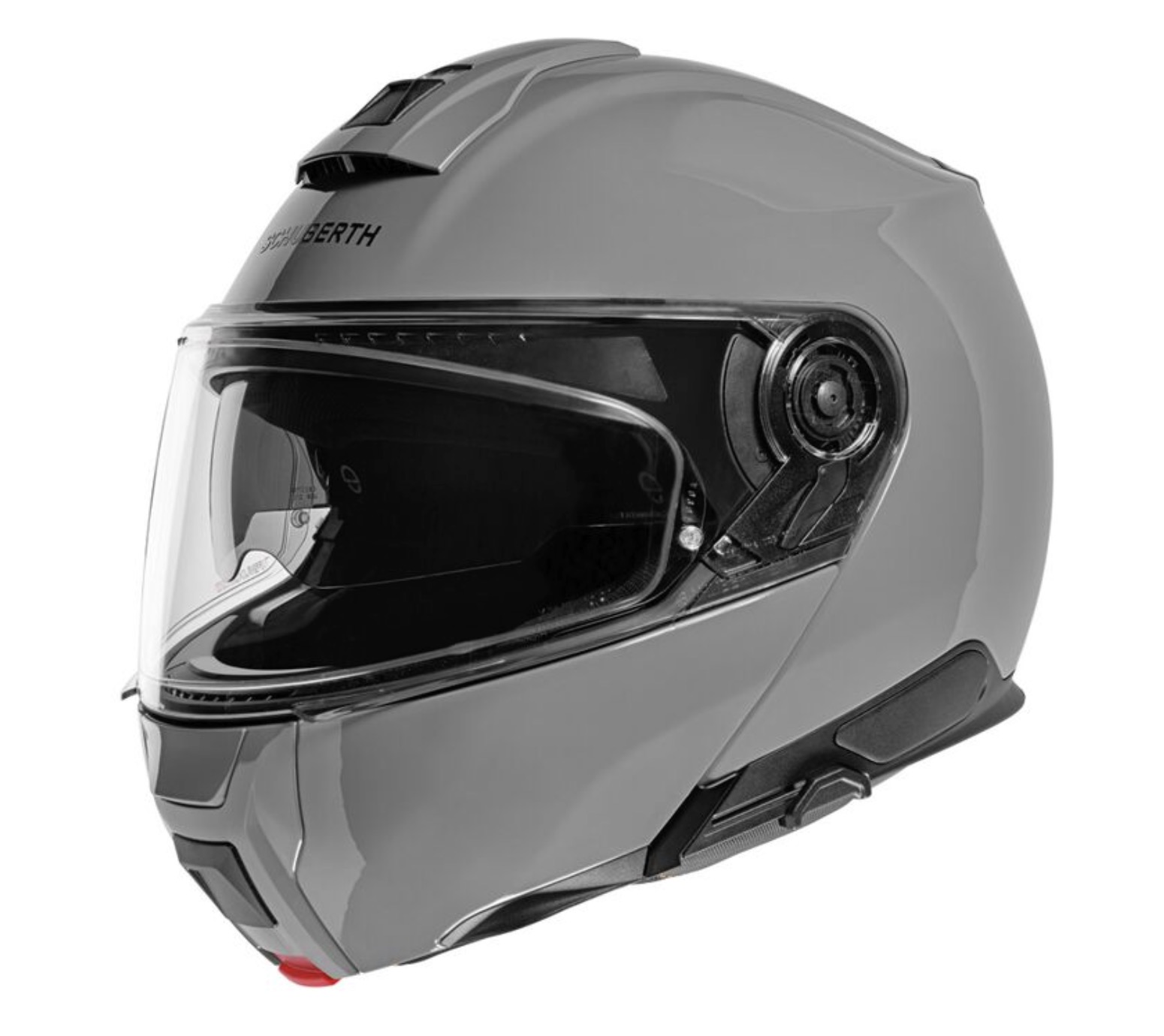
Schuberth C5 Helmet
The quietest touring helmet money can buy, kitted out with all the features you expect for those long days in the saddle.
- Modular flip up chin bar
- Drop down sun visor
- Space for integrated comms unit
- Many colorway options
- DOT certified, with ECE in EU
- Heavier than most full-face helmets
- Visor mechanism needed refinement early on
The Schuberth C5 is worth the similar price if you care most about modular convenience and noise reduction. The GT-Air 3 is the pick if you want a lighter, simpler full-face with a proven SHARP 5-star rating. Riders facing the same Shoei-vs-Schuberth dilemma in ADV territory can run our Shoei Hornet X2 vs Schuberth E2 comparison to see how the brand rivalry plays out off the pavement.
At-a-Glance: Specs & Price
| Specs | Shoei GT-Air 3 | Schuberth C5 |
|---|---|---|
| Type | Full-face | Modular (flip-up) |
| Weight | ~3.78–3.91 lb (size M) | ~3.6–3.8 lb (size M) |
| Fit/Shape | Intermediate oval, 3 shell sizes | Intermediate oval (slightly rounder), 2 shell sizes |
| Shell/Materials | AIM fiberglass composite (fiberglass + organic fibers) | DFP fiberglass with carbon-fiber reinforcement |
| Safety/Cert | DOT (US); ECE 22.06 (EU); SHARP 5-star | DOT + ECE 22.06; P/J dual homologation; SHARP 4-star |
| Ventilation | Chin vent (with insect filter), 2-stage forehead vent, top exhaust ports | 2 chin vents (with exchangeable filters), top vent, rear exhaust |
| Visor/Sun Shield | CNS-1C Pinlock-ready shield + QSV-2 drop-down sun visor | SV6 Pinlock 120-ready shield + integrated drop-down sun visor; visor memory function |
| Comms Readiness | Pre-formed recesses for Sena SRL3 (sold separately) | Pre-installed speakers + antenna for Sena SC2 (sold separately) |
| Warranty | 5 years from purchase (7 years from manufacture) | 5 years from purchase (worldwide) |
| Price (typical) | $750–$880 (as of early 2026) | $750–$850 (as of early 2026) |
Who Each Product Is Built For
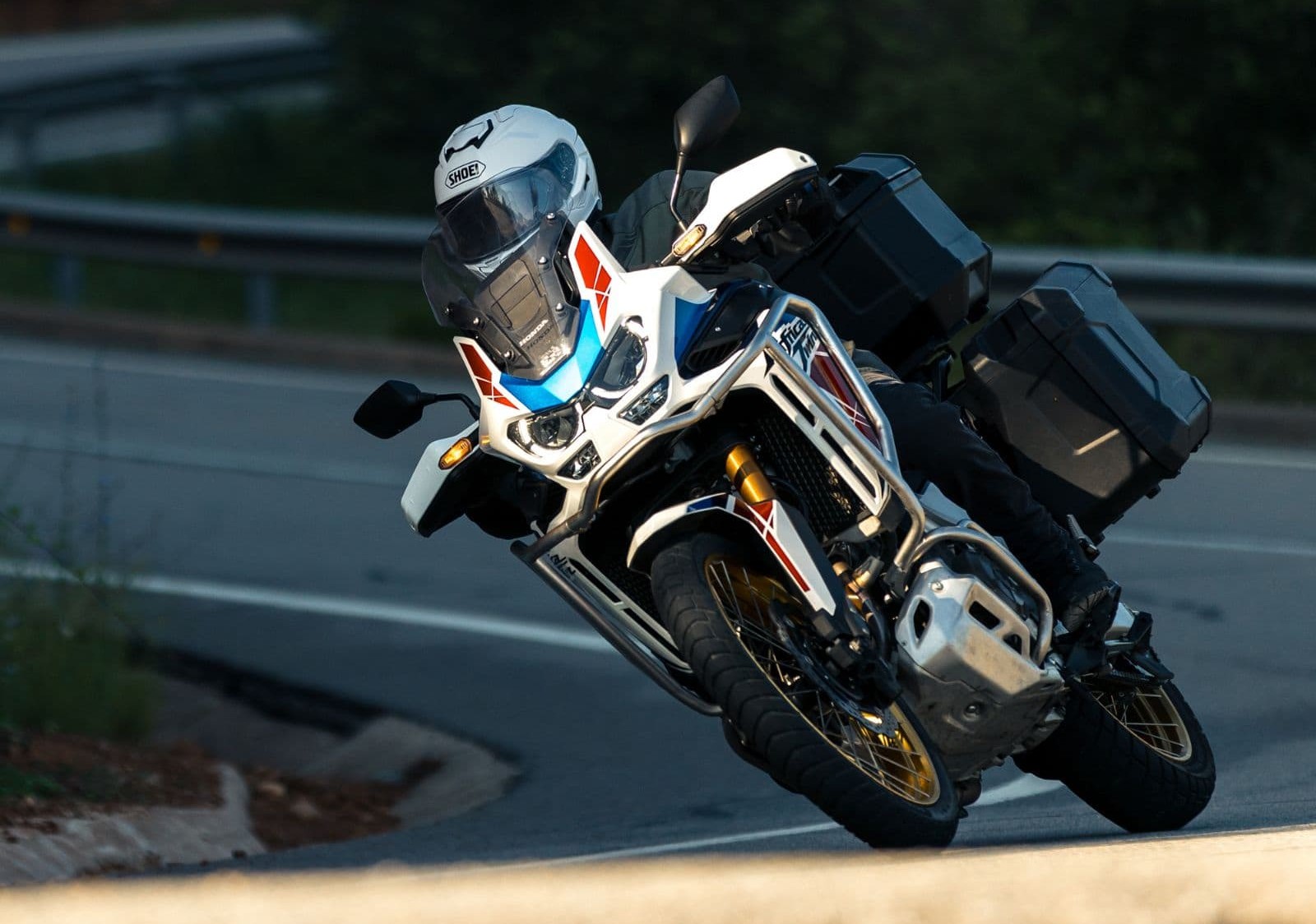
The Shoei GT-Air 3 Rider
- You ride sport-touring or naked bikes and want a single full-face lid that handles commutes and weekend blasts without feeling bulky
- Ventilation is a priority. The GT-Air 3’s redesigned vents push 17.5% more intake air and 81.3% more exhaust air than the GT-Air 2
- You’ve worn Shoei before and your head matches their intermediate oval shape. I have been to the Shoei gallery many times in Japan to see different Shoei helmets like the GT-Air 3 and the Neotec 3, and the hand-built quality is evident up close
- You value a proven safety rating: the European GT-Air 3 earned 5 out of 5 stars from SHARP independent testing
The Schuberth C5 Rider
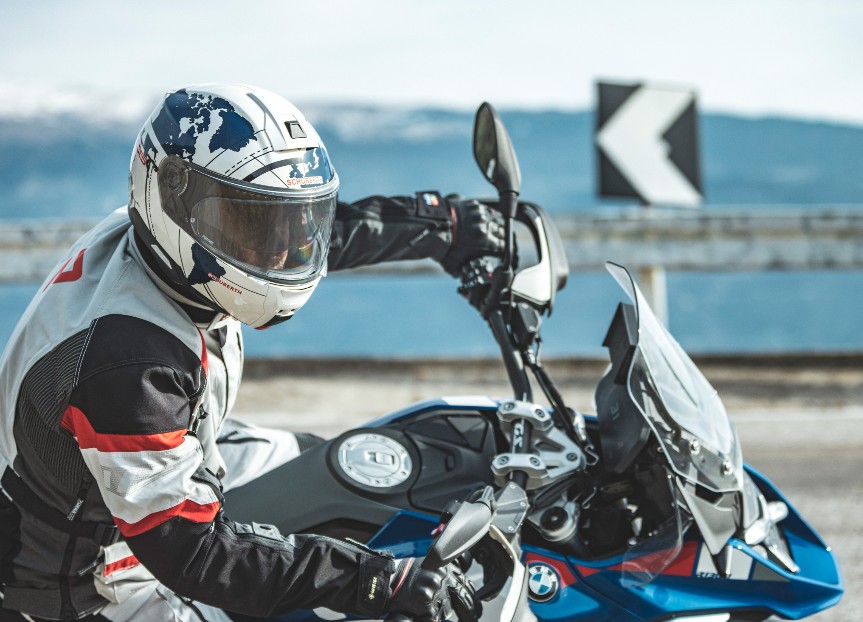
- You ride a touring or adventure bike and flip the chin bar up constantly at fuel stops, for photos, or to chat without pulling off the whole helmet
- Highway noise drives you up the wall. Independent reviewers measure the C5 at around 85 dB at 60 mph, quieter than many full-face lids
- Your head trends slightly rounder than a typical Shoei fit, and Schuberth’s Individual Concept kits let you dial in the pad thickness
- You want P/J dual homologation: crash-tested and legal to ride in both open and closed positions
What Riders Report (Hands-on & Owner Feedback)
Shoei GT-Air 3 owners love:
- Wind-tunnel quiet. Multiple owners call this the quietest Shoei full-face they’ve worn. The reviewer we work with described riding for hours without ear protection and being impressed by how much noise the shell filtered out.
- Ventilation that delivers. The redesigned vent layout pushes noticeably more air than the GT-Air 2. Owners in warm weather report good airflow even in traffic.
- Comfort from day one. Shoei’s 3D Max-Dry liner and snug cheek pads earn praise across the board. Glasses slide in and out with no resistance.
Shoei GT-Air 3 owners flag:
- Center visor tab takes adjustment. Shoei moved the visor release from the side to the center. Some riders find it less intuitive with thick gloves or a chin-mounted camera.
- Inner sun visor can fog in cold weather. Moisture from your breath can creep behind the retracted sun visor and fog it when deployed. Not a problem in warmer conditions.
Schuberth C5 owners love:
- Remarkable silence. This shows up in nearly every owner report. The reviewer we work with found it quieter than the Shoei Neotec 2 with less buffeting at speed.
- Phenomenal top vent. Open it and you feel cool air rushing across your scalp. The chin vent also excels at clearing a foggy visor fast.
- Easy modular operation. The chin bar releases smoothly from a center-mounted button. Quick, one-hand access when you stop.
Not Sure What Size to Order? Get Our Gear Fit Guide.
Sizing charts for helmets, jackets, gloves & boots — with brand-specific fit notes and pro tips so your gear fits right the first time.
- Helmet sizing by brand
- Jacket, glove & boot charts
- Head shape guide
- Between-sizes tips
Schuberth C5 owners flag:
- Visor drop issue (fixable). Some early units had the visor slowly dropping while riding. The reviewer documented this and shared a simple, inexpensive fix in this Schuberth C5 five-month review.
- Only 2 shell sizes. For a premium helmet, two shell sizes means smaller heads may look oversized compared to Shoei’s three-shell approach.
Head-to-Head by Category
Noise at Highway Speeds
The C5 wins this one. Independent tests measure it around 85 dB at 60 mph. Schuberth’s wind-tunnel-developed shell, dense neck roll, and tight visor seal create an almost insulated feel at speed – and for how that acoustic engineering holds up against a sub-$300 flip-up, our Schuberth C5 vs EXO-GT930 comparison quantifies the gap.
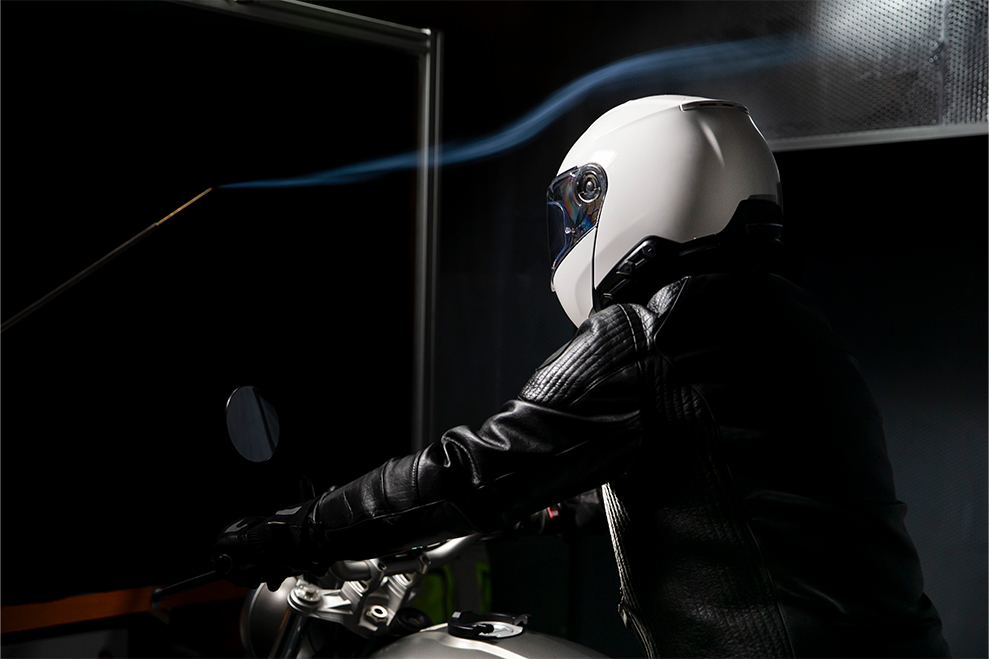
The GT-Air 3 is one of the quietest full-face Shoeis ever made, with clear improvements over the GT-Air 2 – this long-term GT-Air 3 review walks through how the acoustic tuning holds up day to day. But it doesn’t match the C5’s cocoon-like hush. If you ride without earplugs and care about long-term hearing, the C5 has a measurable advantage.
Weight and All-Day Fatigue
Surprisingly close. The GT-Air 3 weighs roughly 3.78–3.91 lb (size M). The C5 lands around 3.6–3.8 lb.
On the road, the GT-Air 3 feels stable and planted thanks to its aerodynamic profile (Shoei claims 6% less drag and 11% less lift vs. the GT-Air 2). The C5 feels slightly more insulated and bulky despite similar weight because of the modular mechanism. For very long days, the GT-Air 3’s simpler design may be easier on your neck. If weight itself is your primary concern, AGV’s K6 S drops well below both – our GT-Air 3 vs AGV K6 S comparison covers how much that savings buys you in real-world use.
Ventilation in Heat
The GT-Air 3 pulls ahead. Its chin vent with insect filter, two-stage forehead vent, and four exhaust ports through the EPS liner push significantly more air than the GT-Air 2. Picture yourself stuck at a red light in August: the GT-Air 3 is going to keep you cooler.
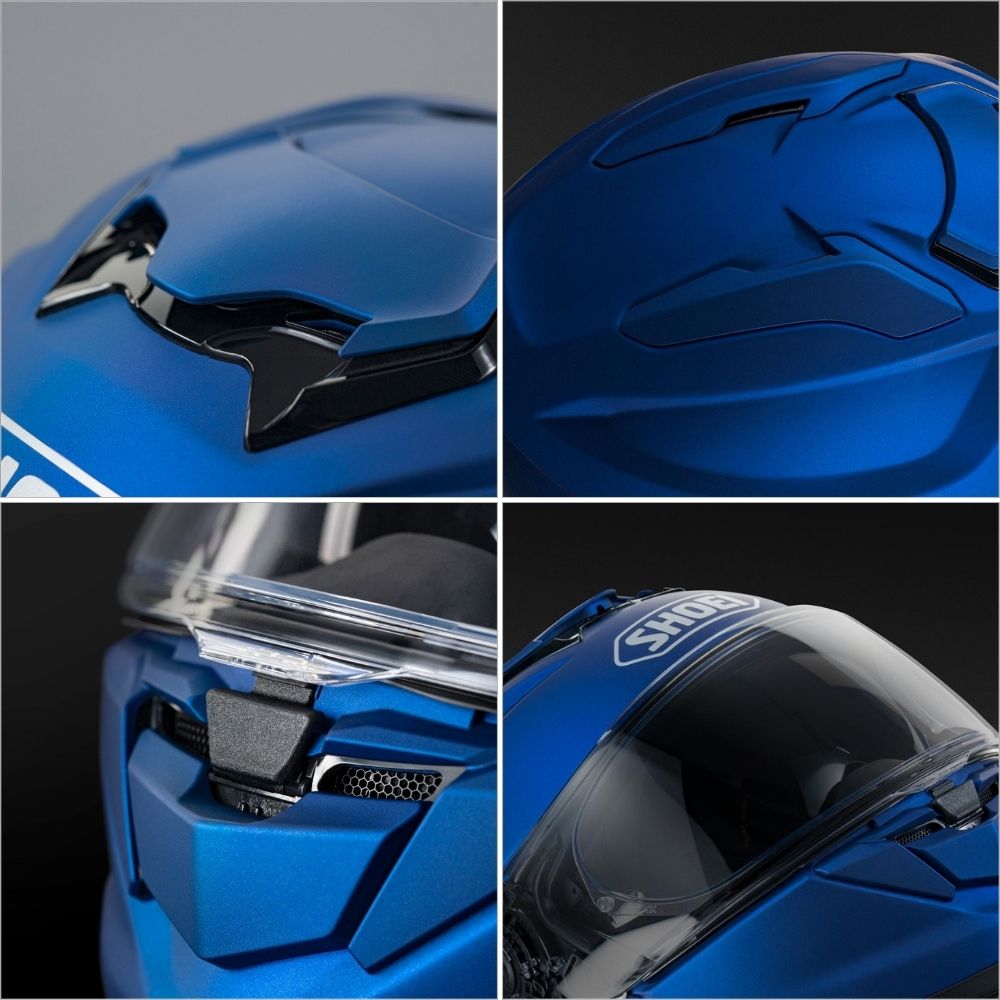
The C5’s top vent is excellent (owners rave about the rush of cool air), but the helmet prioritizes sealing and noise over raw airflow. If you tour in cooler climates, this won’t matter. For the southern US, the Middle East, or Southeast Asia, the GT-Air 3 breathes better.
Visor and Sun Shield Usability
Both come with Pinlock-ready shields and integrated drop-down sun visors, but the details differ.
The GT-Air 3’s new center-locking visor provides wide peripheral vision and works with both hands. Downside: if you mount a camera on the chin, the mechanism gets in the way. The C5 counters with its patented visor memory function: crack the visor open, flip up the chin bar, and when you close it the visor returns to exactly where it was. That’s a small detail that makes daily riding smoother.
Comms-Ready Fitment
The GT-Air 3 has pre-formed recesses for the Sena SRL3 (sold separately). Clean install, no external clamp kits. Cardo units can be mounted externally but the fit isn’t as tidy. For more on comms-ready lids, check our Bluetooth modular helmets guide.
The C5 ships with speakers and an antenna pre-installed. You just plug in the SC2 module and you’re live on Mesh 2.0 with up to 24 riders. Half the hardware is already in the box, which gives the C5 a slight edge for comms readiness.
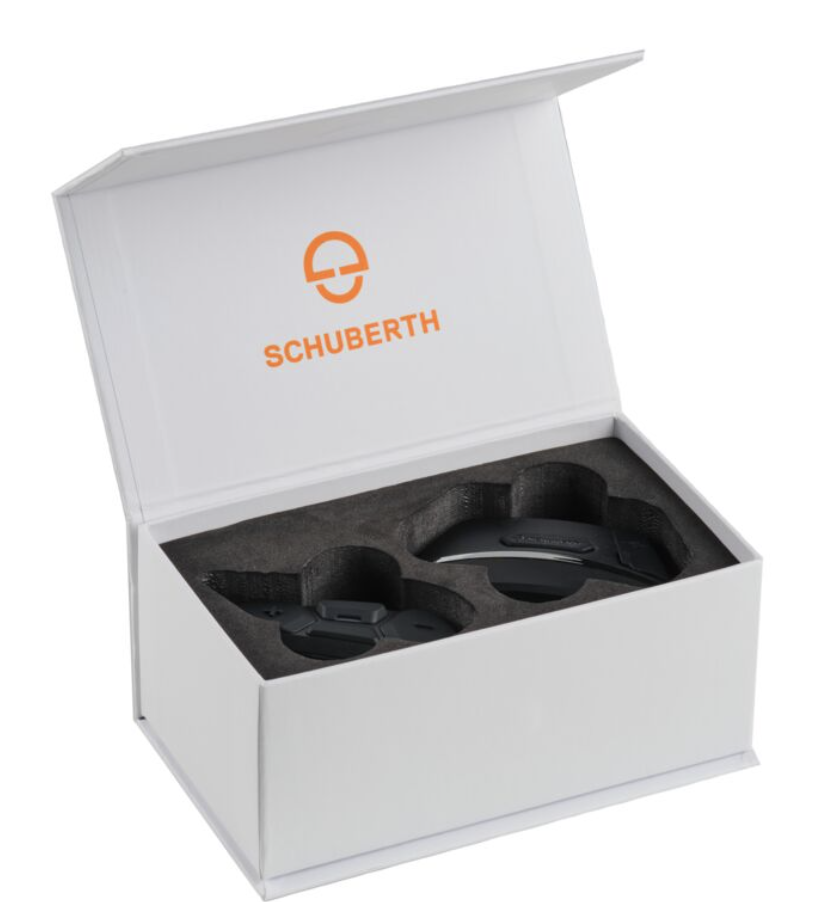
Schuberth SC2 System
Schuberth’s plug-and-play comms system built in collaboration with Sena. Mesh 2.0 lets you chat with a big crew, Bluetooth 5.0 keeps your music and GPS locked in.
Value for Money: Is the Upgrade Worth It?
Here’s the interesting part: these two cost almost the same. Solid-color GT-Air 3 helmets start around $750, with graphics up to $880. Solid-color C5 helmets also sit around $750, with graphics reaching $850 (as of early 2026).
So this isn’t a “which costs more” question. It’s a “which type of helmet is worth your $750” question.
The GT-Air 3 gets you: a 5-star SHARP-rated full-face shell in three sizes, aggressive ventilation, wind-tunnel aerodynamics, and Shoei’s hand-built Japanese quality. You give up the modular flip-up.
The C5 gets you: the quietest modular on the market, P/J dual homologation, pre-installed speakers and antenna for comms, and the convenience of a flip-front. You give up one SHARP star and the GT-Air 3’s stronger airflow.
The choice comes down to whether you need a chin bar that flips up. If you do, the C5 is the one – though our C5 vs Shoei Neotec 3 comparison pits it against the other premium flip-up on price, weight, and noise. If you don’t, the GT-Air 3 is a lighter, simpler alternative with a top-tier safety score.
Good Alternatives
Shoei Neotec 3 (~$900–$1,050): If you want a modular with Shoei’s build quality and don’t mind spending more. Better ventilation than the C5 and a smoother flip mechanism, but not quite as quiet. Check out this in-depth review of this helmet.
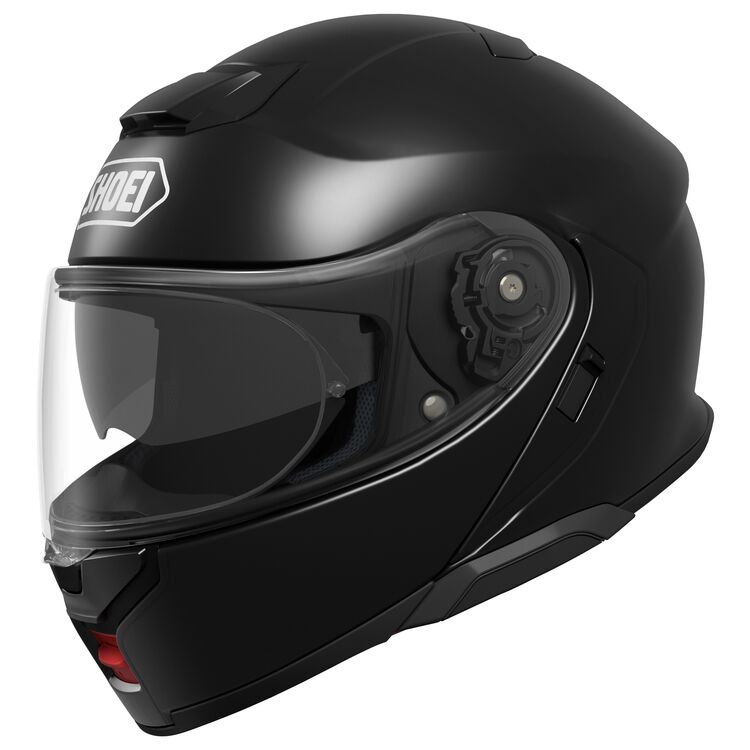
Shoei Neotec 3 Helmet
A premium modular helmet built for long-distance comfort and low noise, with a smooth flip-up chin bar, tightly-sealing visor and wide drop down sun shade. Fits the SRL3 Sena comms system seamlessly.
- Comfortable wear all day
- Quiet, aerodynamic performance
- Flip-front convenience at stops
- Integrated comms & sun visor
- Faceshield lock is sometimes stiff
- Heavier weight may fatigue neck on long rides
HJC RPHA 91 (~$550–$600): A composite modular that delivers a plush interior and solid comms integration for about $200 less than the C5. It’s not as quiet or refined, but it’s a strong pick for riders who don’t want to pay Schuberth prices. See our side-by-side comparison of the Schuberth C5 and HJC RPHA 91, or our GT-Air 3 vs RPHA 91 comparison for a direct matchup.
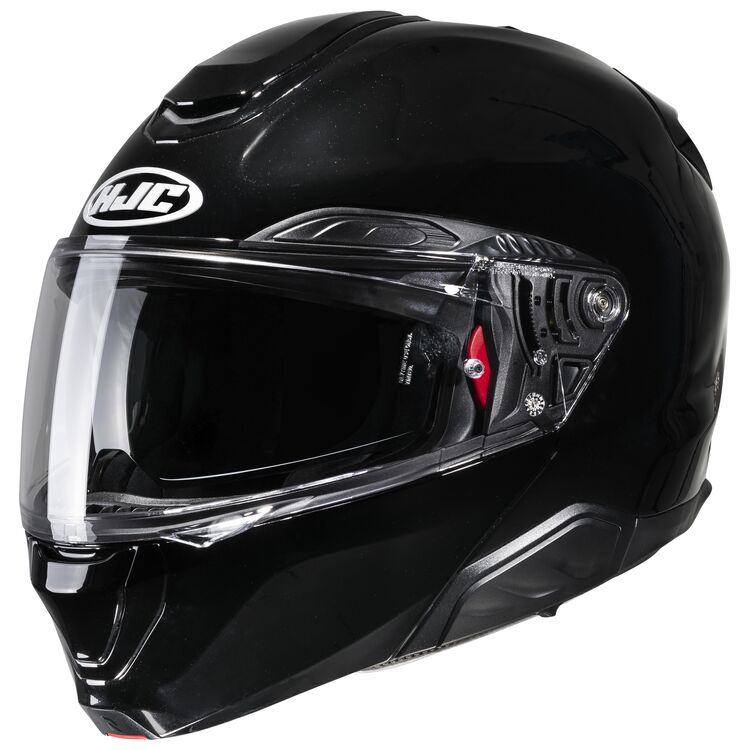
HJC RPHA 91 Helmet
A premium DOT-rated modular helmet combining composite‑shell strength with a smooth flip‑front, quiet ride and adjustable sun visor for long-distance touring comfort.
- Composite PIM Evo shell offers superior impact protection
- Adjustable drop-down sun visor adapts to changing light
- Very quiet for a modular helmet – ~96 dB at highway speeds
- Comfortable, plush liner with interchangeable cheek pads
- Slightly heavy compared to lighter modulars
- Chin bar lock can be finicky to operate with gloves
Shoei RF-1400 (~$550–$680): If you want a lighter, Snell-certified full-face and don’t need a drop-down sun visor. It’s sportier than the GT-Air 3 and about $100 cheaper, but skips the integrated sun shield and ratchet strap – our RF-1400 vs GT-Air 3 breakdown quantifies exactly how much quiet and comfort you’d trade for that lighter sporty shell. Check out our long-term review of this helmet.
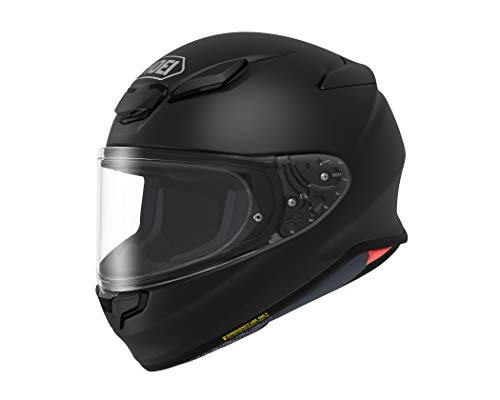
Shoei RF-1400 Street Helmet
$649.99
One of the top motorcycle helmets for street riding due to its incredible safety ratings, solid build construction, versatile shell for street and track riding, and reasonable price. Long term review here.
- Staff pick at Revzilla
- Quietest helmet on the market
- Excellent build quality
- Thick noise-sealing cheekpads
- Visor seal built like Fort Knox
- Snell certified for track use
- Lacking touring comfort features like drop down sun shield
FAQ
Is the Shoei GT-Air 3 a full-face or modular helmet?
The GT-Air 3 is a full-face helmet. The chin bar does not flip up. If you need modular convenience, look at the Shoei Neotec 3 instead, which shares many of the GT-Air 3’s features in a flip-up design. We compared them in our Neotec 3 vs GT-Air 3 article.
Can I use a Cardo comms system with the GT-Air 3 or C5?
The GT-Air 3 is designed for the Sena SRL3 but can accept a Cardo unit mounted externally. One reviewer found the Cardo Packtalk fits just below the sun-shield slider, though it sits further back than ideal. The C5 is designed for the Sena SC2 system, but the latest SC2 models now support Cardo Packtalk Edge connectivity as well.
Which helmet is quieter, the GT-Air 3 or C5?
The Schuberth C5 is quieter. Independent tests consistently measure it around 85 dB at highway speeds. The GT-Air 3 is one of the quietest full-face helmets on the market, but the C5’s noise isolation is a step above. For a wider look at quiet options, check our quietest modular helmets roundup.
Do both helmets fit glasses?
Yes. Both the GT-Air 3 and C5 are designed with grooves in the interior padding that accommodate eyeglass arms. The reviewer we work with tested glasses in the GT-Air 3 and reported they slipped in and out easily with no pressure on the temples.

Are both helmets ECE 22.06 certified?
The European versions of both helmets carry ECE 22.06 certification. In North America, the Schuberth C5 carries both DOT and ECE 22.06, while the Shoei GT-Air 3 carries DOT only. Shoei builds separate versions for different markets, and the North American GT-Air 3 was not submitted for ECE certification since it already carries DOT. Both helmets also appear in our best touring helmets roundup.
How long do these helmets last?
Both come with 5-year warranties from the date of purchase (Shoei also extends to 7 years from the date of manufacture, whichever comes first). Most manufacturers recommend replacing a helmet after 5 years of regular use regardless of condition, as the EPS liner and shell materials degrade over time.
Best for lightweight full-face touring |
Best for whisper-quiet modular riding |
A premium touring helmet built to disappear on long rides: plush liner, adjustable vents, thick neck-roll and tight sealing visor for that sweet sweet silence and an optically-clear drop down sun shield. Fits the SRL3 Sena comms system seamlessly. | The quietest touring helmet money can buy, kitted out with all the features you expect for those long days in the saddle. |
|
|
|
|
A premium touring helmet built to disappear on long rides: plush liner, adjustable vents, thick neck-roll and tight sealing visor for that sweet sweet silence and an optically-clear drop down sun shield. Fits the SRL3 Sena comms system seamlessly.
- Super quiet
- Wind tunnel molded for smoother ride (less fatigue)
- Eyeglass compatible
- Internal sun shade and Pinlock visor
- A bit heavier than carbon‑shell alternatives
- Ratchet strap may irritate throat
The quietest touring helmet money can buy, kitted out with all the features you expect for those long days in the saddle.
- Modular flip up chin bar
- Drop down sun visor
- Space for integrated comms unit
- Many colorway options
- DOT certified, with ECE in EU
- Heavier than most full-face helmets
- Visor mechanism needed refinement early on