
Best Scorpion Motorcycle Helmets (2026): 6 Picks by Riding Style
 Evan Rally
left for contents
Short on time? Buy the EXO-R1 Air. Stephen from MotoStories and More rode one for a season and wrote it up for this site, its shell is a fiberglass, aramid and poly-resin laminate rather than moulded plastic, and Scorpion’s own spec sheet puts DOT and ECE 22.06 on it. Tour more than you scratch? Take the EXO-ST1400 Evo.
Scorpion is where you land after you’ve priced a Shoei and looked at your bank balance. Working out which Scorpion is the hard part. Thirty helmet names sit in the model filter on the brand’s own US site, the badges change between America and Europe, and most of the safety ratings a search hands you belong to a European helmet with a different strap on it. So let’s sort the US range by what you actually ride.
Quick picks
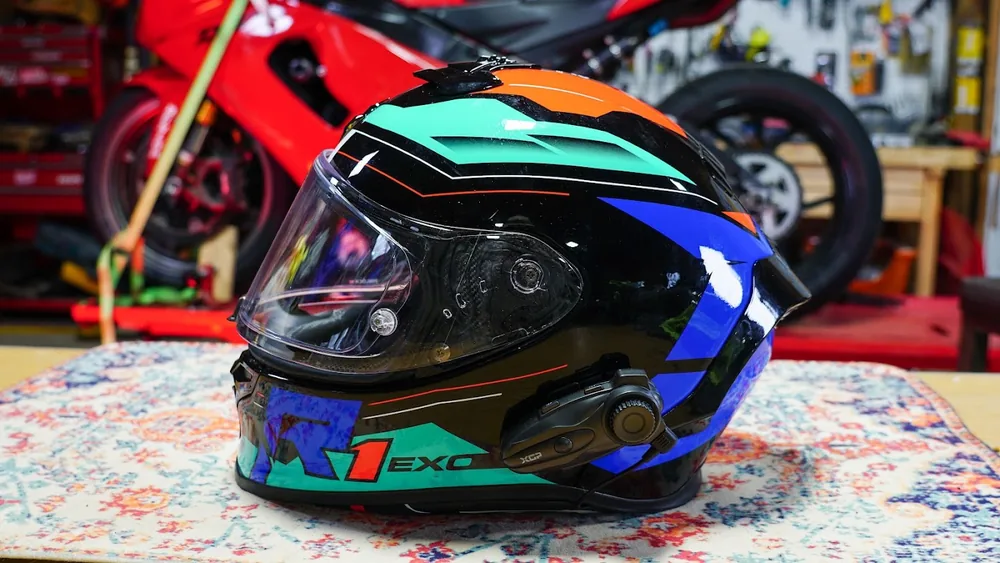
- Best overall, and best on a sportbike: EXO-R1 Air. Composite shell, inflatable cheek pads, DOT and ECE 22.06. It’s also the one with a full season of Stephen’s riding behind it.
- Best for sport touring: EXO-ST1400 Evo Carbon. Carbon shell, drop-down sun visor, Pinlock in the box.
- Best for adventure riding: EXO-AT960. Huge eye port, goggle-friendly, and heavy.
- Best modular for the money: EXO-GT930 Transformer. Chin bar and peak both come off, dual DOT and ECE P/J homologation.
- Best for cruisers: Covert X. One helmet, three configurations. Just don’t mistake that mask for a chin bar.
- Best budget full face: EXO-R430. Snell 2025 and DOT at the cheapest end of the range, and nobody has published a test of it.
The six at a glance
| Helmet | Best for | Type | US certification | Weight | SHARP | Price vs EXO-R430 |
|---|---|---|---|---|---|---|
| EXO-R1 Air | Sport, track | Full face | DOT + ECE 22.06 (Scorpion) | 3.28 lb (RevZilla) | No SHARP rating | ~2.5x |
| EXO-ST1400 Evo Carbon | Sport touring | Full face | DOT + ECE, rev. n/a (J&P) | 3.05-3.44 lb (J&P) | No SHARP rating | ~2.7x |
| EXO-AT960 | Adventure | Modular with peak | DOT + ECE 22.06 P/J (Scorpion) | 4.16 lb (webBikeWorld) | No SHARP rating | ~1.8x |
| EXO-GT930 Transformer | Modular touring | Modular, chin bar off | DOT + ECE 22.06 P/J (Scorpion) | 3.81 lb (Ultimate Motorcycling) | No SHARP rating | ~1.6x |
| Covert X | Cruiser | Half helmet + mask | DOT only (Scorpion); mask not crash-rated | 3.5 lb (webBikeWorld) | No SHARP rating | ~1.9x |
| EXO-R430 | Budget full face | Full face | DOT + Snell 2025 (Scorpion) | Not published | No SHARP rating | 1x (baseline) |
The thing that trips up most Scorpion shopping is the badge problem. Scorpion sells different helmets under confusingly similar names on either side of the Atlantic, so the SHARP star rating somebody links you on a forum is a different helmet’s. Work out which one you’re actually looking at before you let a star score decide anything for you.
And read the certification block on the helmet you’re actually buying. Two of these six carry no ECE rating at all on Scorpion’s own product pages: the Covert X is DOT only, and the R430 pairs DOT with Snell instead.
Scorpion EXO-R1 Air: best overall
The Scorpion EXO-R1 Air is the helmet that made people take the brand seriously, and it’s still the one I’d hand a rider who wants one Scorpion and no regrets. Scorpion’s US product page describes a multi-layered Ultra-TCT shell that “combines fiberglass, aramid and poly-resin fibers which minimize weight while maximizing strength and impact dispersal”, in “3-Shell sizes for a precision fit”, and lists it as “DOT FMVSS No. 218 Certified / ECE 22.06 Approved”. That’s a laminate shell in a bracket where injection-moulded polycarbonate is the norm.
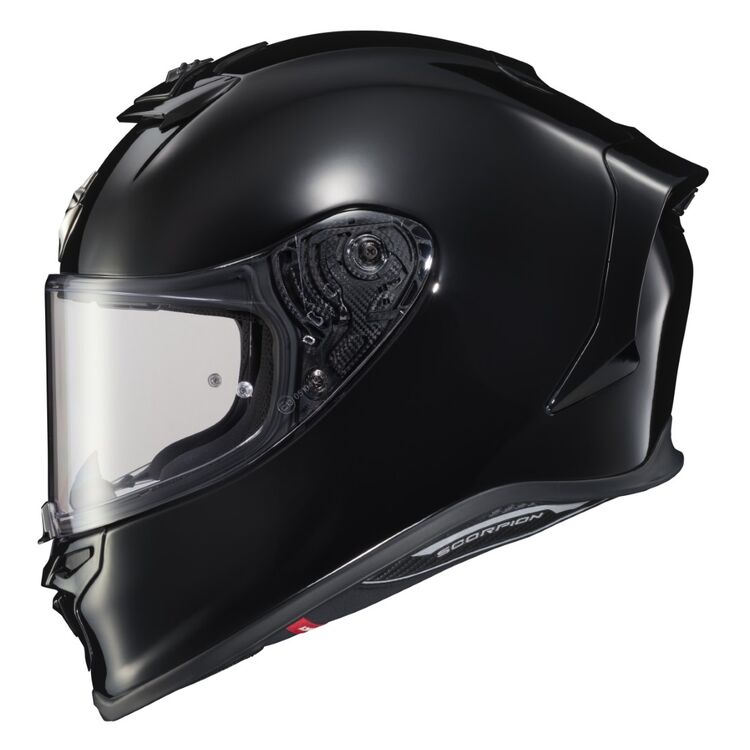
Track-proven performance meets everyday road comfort in this race-inspired helmet.
- Lightweight Ultra-TCT shell with excellent impact dispersal
- AirFit system offers a snug, customizable fit
- Includes both clear and dark smoke Pinlock-ready face shields
- Runs snug for some users, may require sizing up
The party trick is the AirFit system. RevZilla’s product page describes an “AirFit inflation adjustment system between the cheek pads and shell provides a custom fit reducing wind noise and lift”, lists the shape as Intermediate Oval and the weight at 3.28 lb, and shows “Customer rating is 4.5 out of 5 stars. 188 total customer reviews”. That’s a count, not a verdict. You can’t ride a star average.
What it’s like to wear comes from Stephen, who’s been riding, in his own words, “since 1987, on and off the track”. His scale disagreed with the retailer’s: “The scale confirmed it: around 1,400 grams for my size: Large.” He went in a pump sceptic and came out converted: “inflating those pads snugged the helmet down perfectly, eliminating even the slightest wiggle during rapid transitions and when hanging off the bike”. On noise, Stephen was surprised: “Wind noise was present, but surprisingly subdued for such a light, race-focused helmet”. And if you wear glasses, so does he: “I wear prescription glasses, and they fit comfortably inside this helmet.” Full write-up: Stephen’s EXO-R1 Air review.
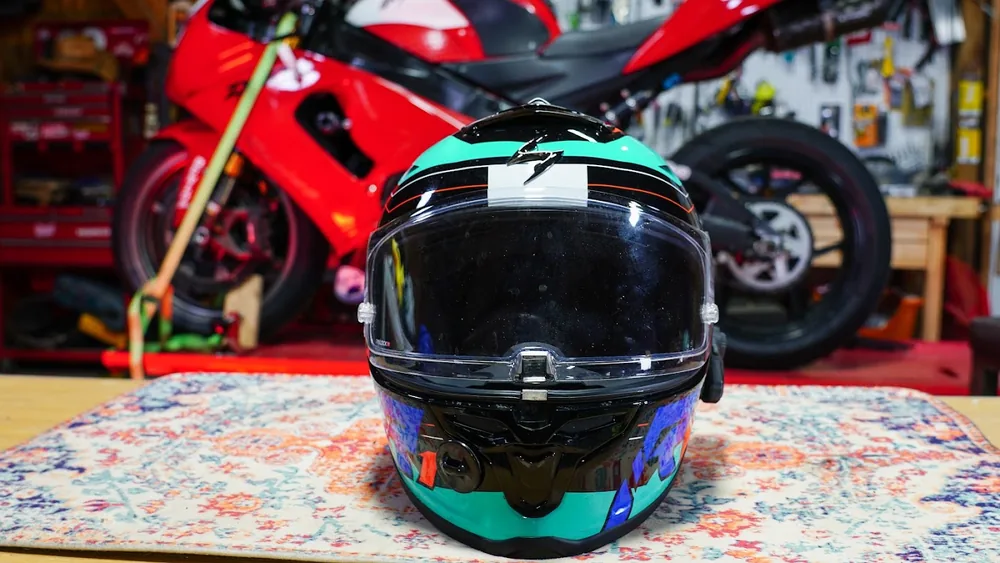
The catch
Two of them, and they’re both Stephen’s. The paint first: “The clear coat on the paint is soft. Too soft, in my opinion.” Cosmetic, and real. Then the chin, if you run an action camera down there, because Stephen found that “the R1 Air’s aggressive, angular chin design presents a challenge” for adhesive mounts. The fit runs tight by design, which he calls right rather than wrong: “It’s definitely tighter than a touring helmet, which is exactly what you want for spirited riding.” Size up if you’re between sizes.
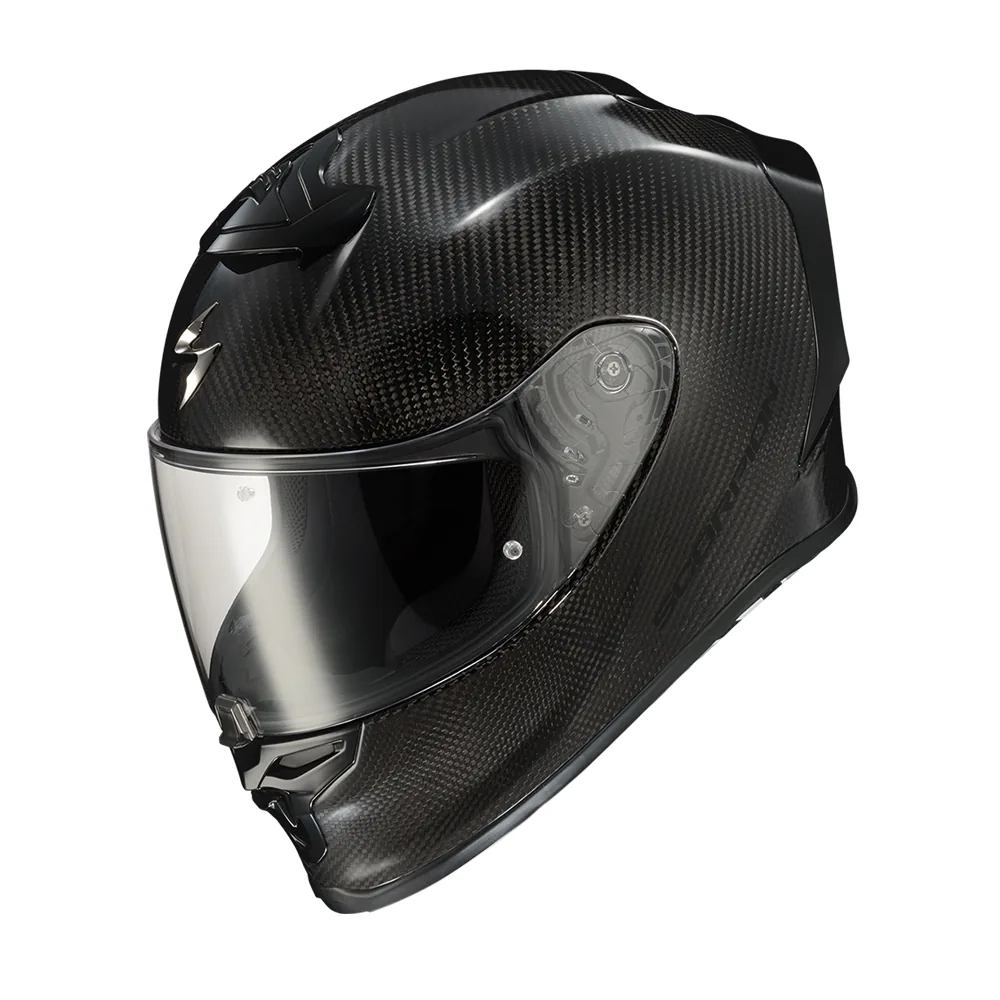
Two more things, both about the R1 Air’s neighbours. It isn’t the top of Scorpion’s US range any more: the EXO-Warp now prices above it, on what Scorpion’s product page calls “Lite Force Carbon Matrix Shell Technology”. Scorpion’s certification claim for the Warp is scoped, and worth reading exactly as written: “Our Race model has earned triple certification FIM Racing #2, ECE 22.06 and DOT FMVSS No. 218.” No independent test of the Warp has turned up that I can find. And there’s a Scorpion EXO-R1 Air Carbon, a real carbon shell and a clear step up in price. I can’t find a test of that one either, and there’s no published weight.

ScorpionEXO R1 Air Carbon Helmet delivers high-end protection, comfort, and tech-ready features for serious riders.
- Lightweight carbon fiber shell for maximum impact protection
- AirFit cheekpad system allows for on-the-fly fit customization
- Bluetooth-ready speaker pockets for easy communication setup
- Massively underpriced for its quality
- Paint job is fragile
Want to cross-shop outside the brand? Our sport bike helmet roundup puts the R1 Air Carbon against the Shoei RF-1400, the AGV K6 S and the track-only end of the market, and the RF-1400 is what Stephen measures his own helmet against in his review.
Scorpion EXO-ST1400 Evo: best for sport touring
The Scorpion EXO ST1400 Evo Helmet is the R1 Air’s civilised cousin: same intermediate-oval house shape, same AirFit pump, plus the drop-down sun visor a sportbike helmet leaves out. The J&P Cycles listing describes a “Resin-infused TCT-U 3K carbon fiber shell” in three shell sizes, “Additional Pinlock MaxVision shield and Pinlock anti-fog insert included”, and under Safety simply “DOT and ECE approved” without naming a revision. Scorpion’s own page for this helmet is dead, so the retailer listing is the best certification source available, and I can’t find anyone who has published the revision number.
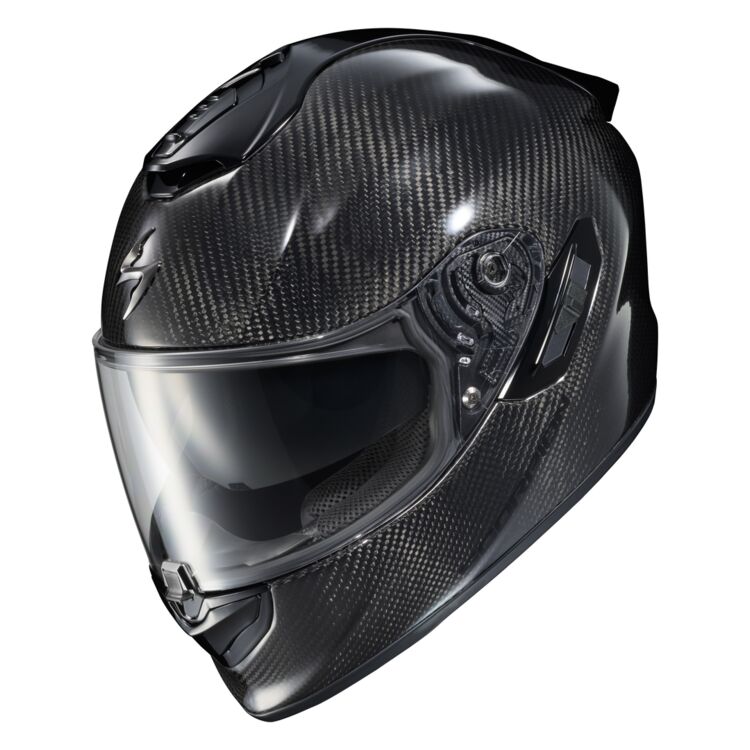
A sleek and lightweight carbon fiber helmet with a sport profile but touring features like a built-in sun visor.
- Ultra-light 3K carbon fiber shell for reduced neck strain
- Drop-down sun visor for quick glare protection
- AirFit inflation system for a custom, snug fit
- Finicky visor release
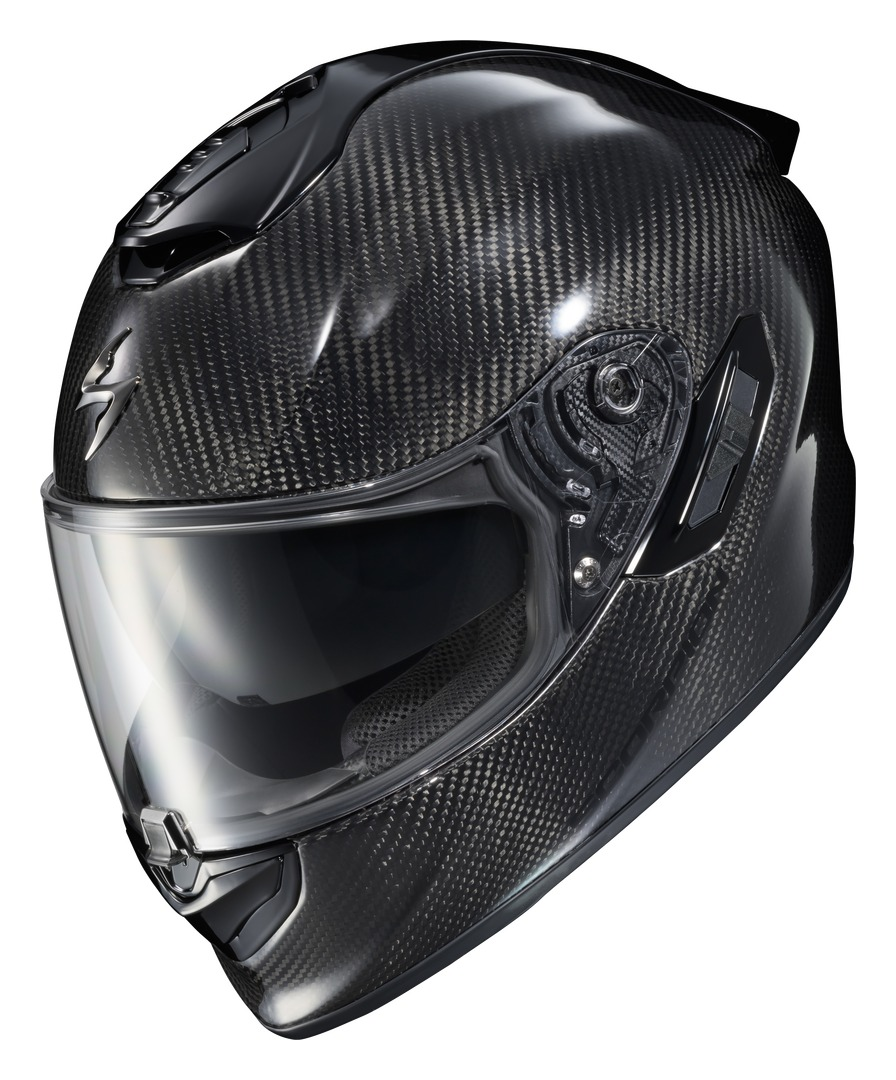
That listing also can’t agree with itself on weight. The description says the helmet weighs “merely 1,383 grams (3.05 lbs), it stands out as one of the lightest helmets in its class”, while the spec block on the same page reads 3.44 lbs. That’s a real gap for one page to carry, and I can’t find anyone who has weighed an Evo independently to settle it.
Brandon Jackson did review the generation before this one for webBikeWorld, the EXO-ST1400 Carbon, and he put it on a scale at “1516 grams (3lbs 5.5oz)”. He called it a helmet that “might very well be the best value currently available in a full-on Carbon Fiber full face helmet”, and he rated the venting unusually highly: “Even at lower speeds (20mph), one can feel air flowing through to the top of the head.” On noise: “I’m pleased to report that the ST1400 does a good job with noise control.” The Evo is a redesign rather than a new paint job, so Jackson’s verdict belongs to the helmet before it and to the family, not to the one in the box today.
The catch
Jackson’s one real complaint on that generation was the internal sun shade: “The only area I really have an issue with is the optical quality of the internal sun shade.” Scorpion has since fitted the Evo with a new Everclear sun visor, which is exactly the part that complaint targeted, and nobody has published a test saying whether it fixed anything. If a distortion-free internal shade is the reason you’re buying, that’s the one thing about this helmet nobody can answer for you yet.
Not Sure What Size to Order? Get Our Gear Fit Guide.
Sizing charts for helmets, jackets, gloves & boots — with brand-specific fit notes and pro tips so your gear fits right the first time.
- Helmet sizing by brand
- Jacket, glove & boot charts
- Head shape guide
- Between-sizes tips
Scorpion EXO-AT960: best for adventure riding
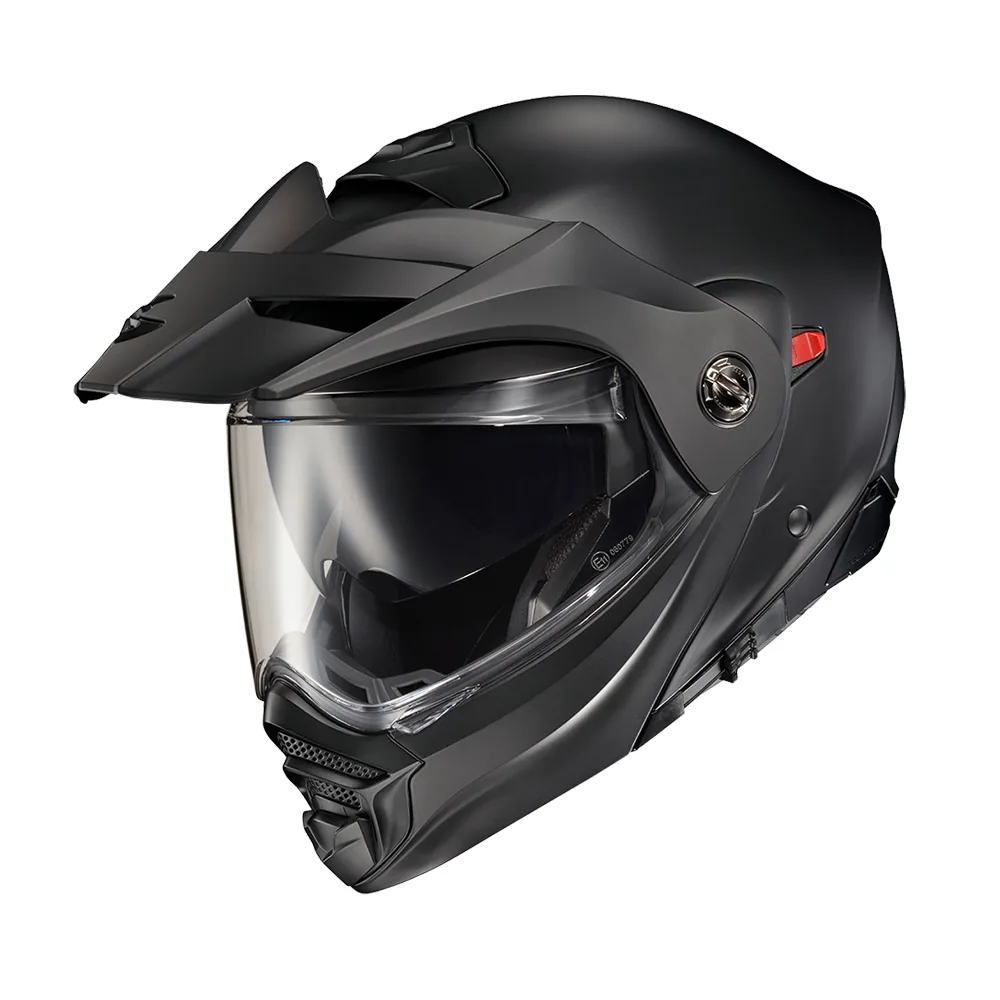
The Scorpion EXO-AT960 Helmet is the default answer in every affordable-adventure-helmet thread, and the spec sheet is why. Scorpion’s US page lists it as “DOT FMVSS No. 218 Certified/ ECE 22.06 (P/J) Certified” with “Three shell sizes made of advanced polycarbonate and dual density EPS”. Peak off for the highway, chin bar up in traffic, internal sun visor for the afternoon.

A do-everything helmet, it's as comfortable on trails as the highway - though not as solid as premium competitors like the Arai XD-5. One of the rare modular ADV helmets, it's also it's DOT and ECE approved.
- Modular chinbar (rare in ADV helmet)
- Removable peak
- Decent airflow
- Drop down sun shade
- DOT and ECE 22‑06 approved
- Susceptible to visor leaks and fogging in heavy rain
- Sun peak vibrates noticeably at highway speeds
Jim Pruner spent “a 4000 mile/6500 km journey that spanned two full weeks in varied weather conditions” in one for webBikeWorld. On the eye port: “One thing I can’t gripe about is the size of the eyeport on the AT960. The field of view is perfect for adventure riding and it can accommodate a set of goggles if the rider so desires.” On stability, which is where peaked helmets usually fall apart: “to my surprise, the AT960 shrugs off those neck-straining gusts better than other adventure helmets I’ve worn.” On noise he’s level rather than glowing: “The AT960 is pretty average for noise levels when compared to other modular helmets. It’s not quiet, but also not painfully loud.”
The catch
It’s heavy. Pruner logs a “Heavy helmet at 4.16 lbs (1.88 kg)” against RevZilla’s listed 4.12 lb, and the peak makes itself known, because “The external peak visor (sun shade) really vibrates in turbulent wind”. Water gets in: “The windscreen/face shield on the AT960 leaks like a sieve.” And the anti-fog coating is not a Pinlock: “Anti-Fog visor coating is inferior to a Pinlock system”. A Pinlock-ready shield is sold separately.
The one to actually check is mechanical. After the off-road leg of that trip Pruner reports: “After many miles of ferocious off-road riding, I noticed one of the latches used to hold the chin bar closed was seized shut.” That’s one latch on one helmet, at the end of a hard two weeks. Still, on any modular the chin-bar latch is the part to work by hand after a dusty day. Cross-shopping: Arai XD-5 vs Scorpion EXO-AT960 and Klim Krios Pro vs Scorpion EXO-AT960.
Scorpion EXO-GT930 Transformer: best modular for the money
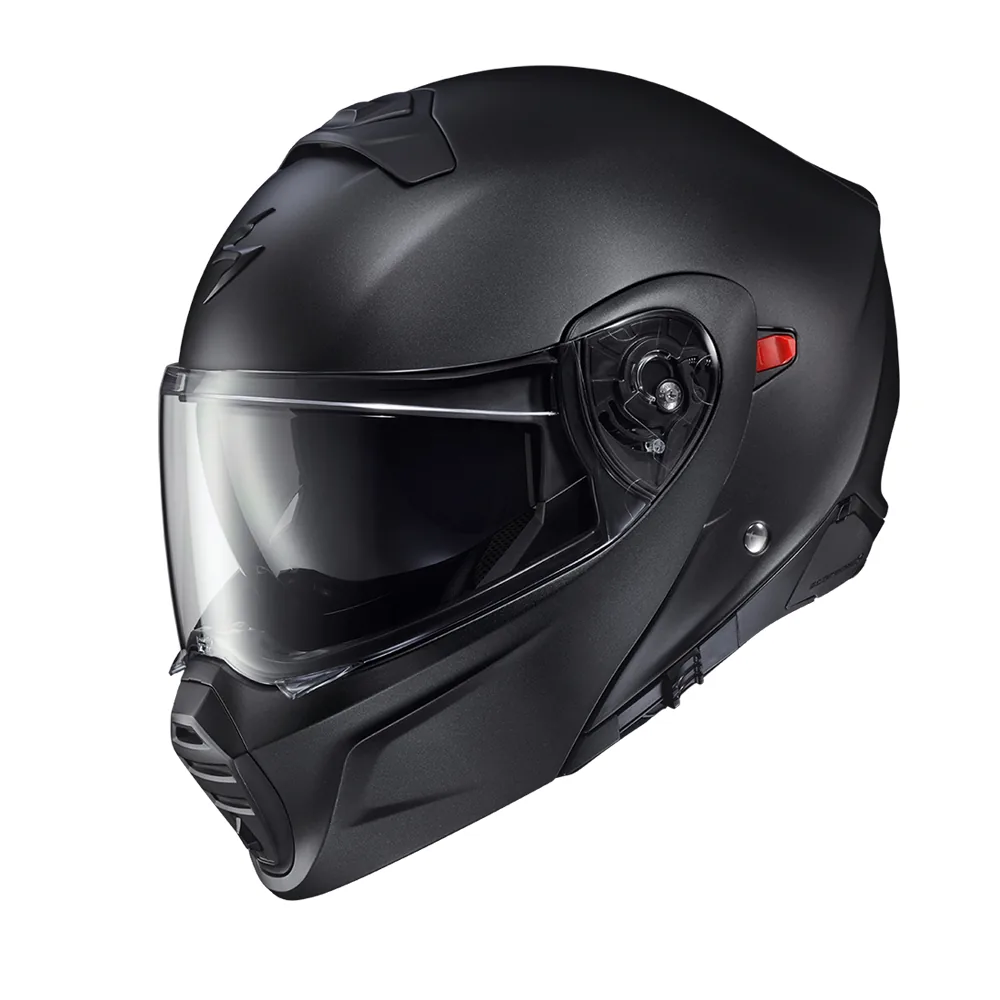
The Scorpion EXO-GT930 is the shape-shifter: chin bar off for a three-quarter helmet, peak on for an adventure profile, chin bar on and peak off for a plain modular tourer. Scorpion’s US page lists it as “DOT FMVSS No. 218 Certified/ ECE 22.06 (P/J) Certified” over an “Advanced Polycarbonate shell”. That P/J is not marketing filler. It means the helmet passed European testing both as a full face and as an open face, so riding with the chin bar up is a homologated configuration rather than something you’re getting away with.
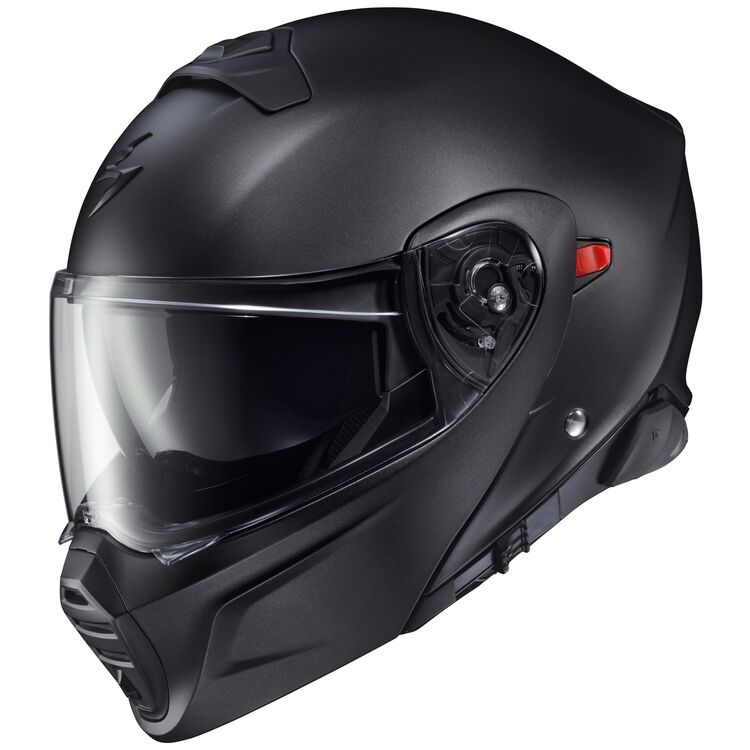
Versatile modular helmet that quickly converts to a 3/4 open face with an internal sun visor and removable peak—offering comfort, ventilation, and hands-free Bluetooth readiness.
- Quick, tool-free conversion from full-face to open-face for riding flexibility
- Internal SpeedView sun visor and anti-fog faceshield keep vision clear on the move
- Dual DOT/ECE P/J homologation ensures legal and safe use in both configurations
- Washable KwikWick liner and good ventilation maintain comfort on long rides
- A bit heavier than average modular helmets; may cause neck fatigue on longer rides
- Ventilation is solid at speed but can feel limited in stop-and-go traffic
Jonathan Handler reviewed one for Ultimate Motorcycling and weighed it himself: “My home scale reads 3 pounds 13 ounces (1730 grams) for the Large size helmet.” He found the mechanism convincing, reporting that “The modular chin bar operates smoothly and has a satisfying, secure click when closed”, and the aerodynamics better than the price suggests: “Spending some time on the road at speed with the GT930, I found it neutral at all speeds with no lift, oscillation, buffeting, or whistling in any position.” He also nails down the shell and the strap: “The shell is polycarbonate with dual-density EPS inside” and “The chinstrap is fastened with traditional double D-rings.” His verdict: “All things considered, the Scorpion Exo-GT930 Transformer helmet is a comfortable quality piece of kit, especially at this price.” Our head-to-head is Schuberth C5 vs Scorpion EXO-GT930.
The catch, and a star rating that isn’t this helmet’s
Handler doesn’t oversell it. He gives it “a subjective wind noise rating of good or average”, which isn’t the same as quiet, and the shell’s polycarbonate rather than composite. That’s where the money was saved.
The bigger thing is a star rating you’ll find if you search, and it belongs to a different helmet. SHARP has tested a Scorpion modular it calls the EXO 930 EVO, reporting that “The Scorpion EXO 930 EVO is a System (Modular/Flip-up) type Motorcycle Helmet that received a 3 Star safety rating when tested by SHARP.” Same numbers in the name, different helmet on the bench: SHARP’s entry lists the retention system as a quick release buckle, and the US Transformer Handler measured has double D-rings. A different strap means a different homologated product, so that three-star result is evidence about a European helmet and not a rating of the one a US shop will sell you. Nobody has published a SHARP figure for the GT930 Transformer.
Scorpion EXO Covert X: best for cruisers, with one hard limit
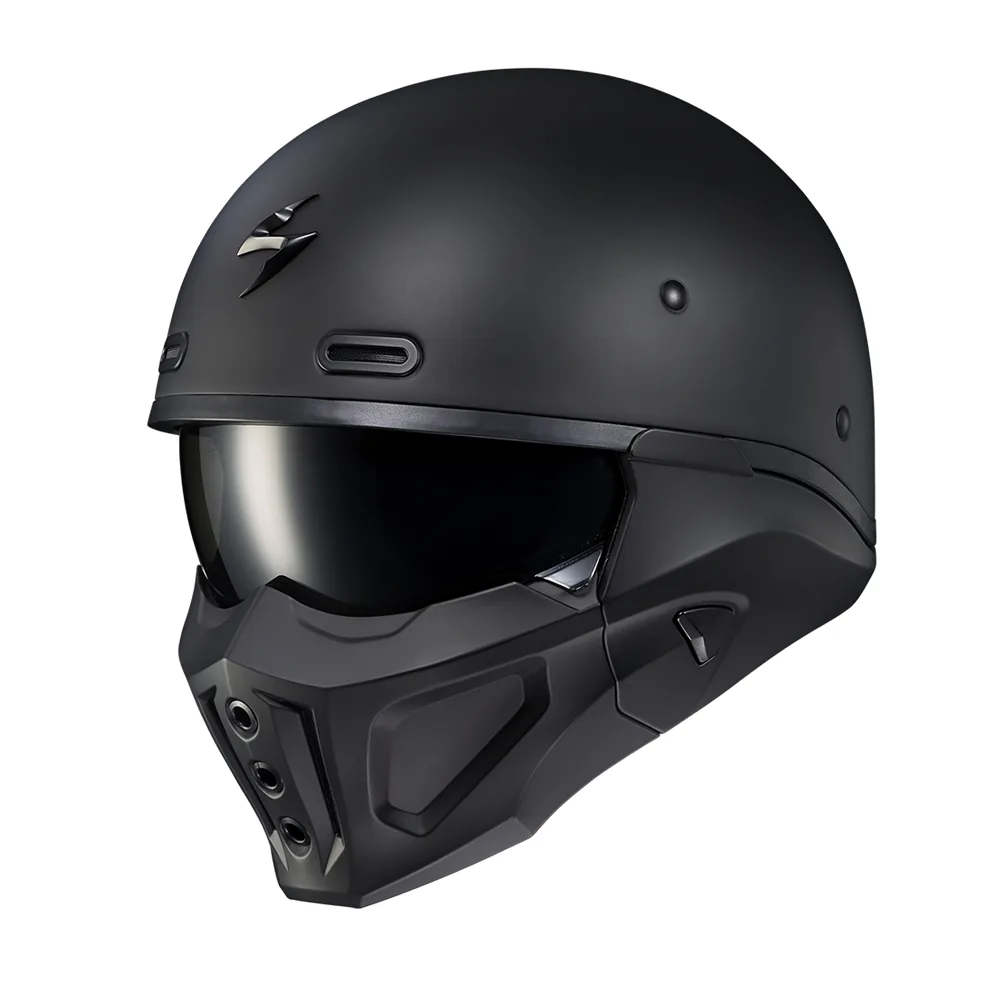
The Scorpion EXO Covert X Helmet gets bought on looks and kept for the versatility. Scorpion’s US page describes a “Unique multi-configuration design featuring removable front mask and rear comfort sleeve results in 3 distinct riding configurations: Full Mode, 3/4 Mode and 1/2 Mode”, over a “Multi-layered TCT-Ultra” shell of fiberglass, aramid and poly-resin, with an “injection-molded polycarbonate mask”.

This helmet combines advanced materials for shell impact absorption usually only seen on pricier lids. Its versatile design allows it to be worn as a half helmet or full face.
- Lightweight, strong TCT-Ultra shell
- Comfortable, ventilated design
- Versatile: full face, open or half helmet
- Small visor
- Only DOT rated
Jared Northcott reviewed one for webBikeWorld back in August 2021, and it’s still the only hands-on test of the Covert X I can find. He put one on his own scale: “On my scale, the full face configuration weighs 3.5 lbs, not too bad for an XL-sized fiberglass helmet”. He liked the view out: “The Covert X has a wide visor opening creating a fantastic field of view.”
That mask is not a chin bar
The certification line on Scorpion’s own Covert X page is one line long: “DOT FMVSS No. 218 Certified”. No ECE. And the front mask that gives the helmet its full-face silhouette is not protective equipment. Northcott says it straight: “The chin bar is simple to add on and completes the full-face mode. Labeled as not being rated for crash protection the bar still has a solid feel to it.”
So the DOT certification belongs to the helmet, and the mask in front of your jaw is styling and wind protection. If you want a chin bar tested to take an impact, this is not the Scorpion that has one. The GT930 Transformer is.
The rest of the gripes are smaller. There’s “No air vent flow regulation”, so the vents are open or absent rather than adjustable. It is not quiet either, and webBikeWorld’s scorecard files that category under the heading “Not Meant To Block The Noise”. The strap is a double D-ring, which Northcott didn’t love: “I am not a fan of Double D ring straps, give me my ratcheting quick release!” On sizing he found the chart trustworthy: “The Covert X Solid is an intermediate oval helmet, I found the sizing chart to be accurate.”
Scorpion EXO-R430: best budget full face
The Scorpion EXO-R430 Helmet is the cheapest thing here and the only one carrying a Snell sticker. Scorpion’s US product page lists the certification as “DOT FMVSS No. 218 Certified/SNELL 2025 Approved”, with a caveat printed underneath that most retail listings drop: “Note: 3X and 4XL DOT only”. If you wear a 3XL or 4XL, the Snell half of that sentence is not yours. The shell is “Advanced Polycarbonate”, and Scorpion’s account of the redesign is that “The advanced polycarbonate shell is more aerodynamic and smaller resulting in an ultra lightweight SNELL-approved helmet.”
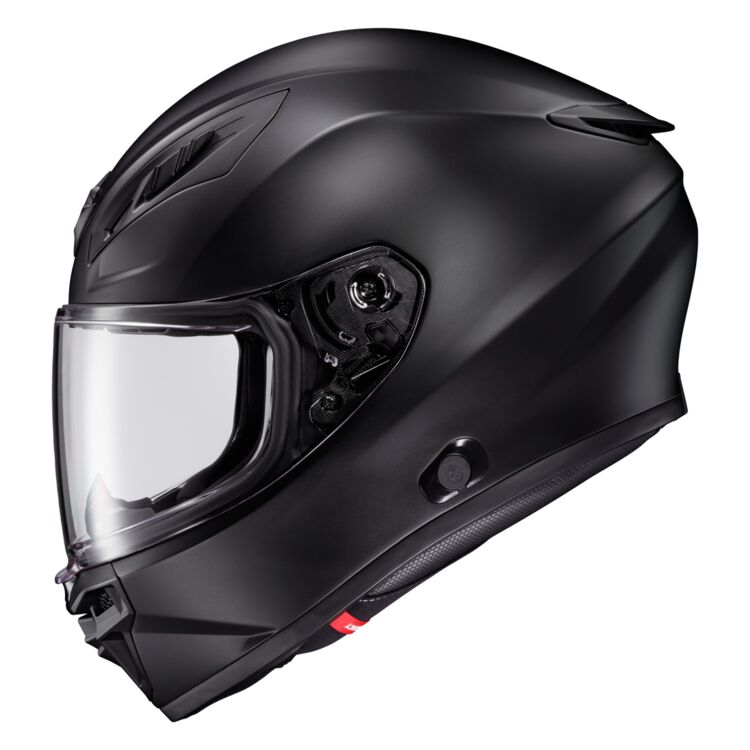
A lightweight, Snell-rated full-face helmet with strong airflow and all-day comfort—ideal for riders who want reliable protection without bulk.
- Lightweight shell reduces fatigue on longer rides
- Strong airflow keeps you cool in warm weather
- Snell rating adds confidence in real-world protection
- Comfort liner stays dry and easy to maintain
- Wind noise higher than premium touring helmets
- Only two shell sizes limit overall fit precision
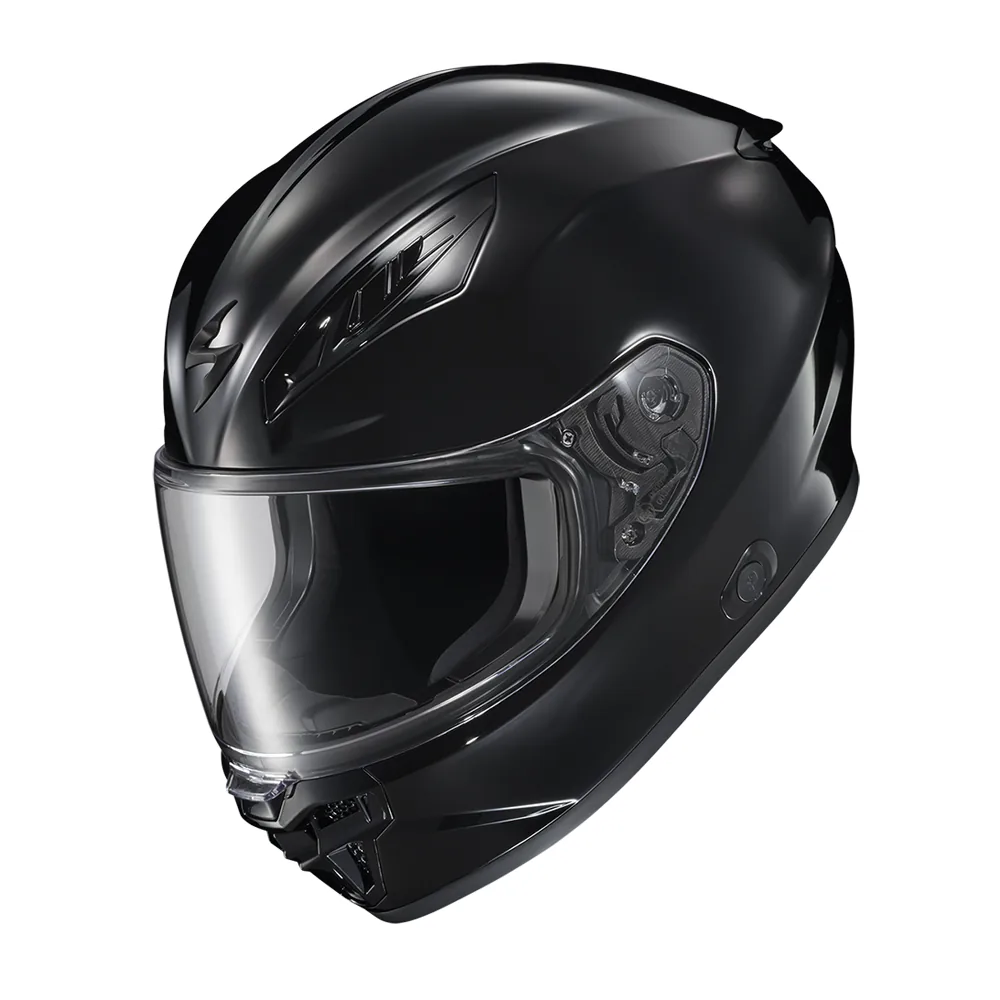
The catch: I can’t find anyone who has ridden one
Nobody’s reviewed the R430 that I can find, SHARP hasn’t tested it, and Scorpion doesn’t publish a weight. What you’re buying is a manufacturer certification, and Snell 2025 at this money is genuinely unusual. How loud it is, how it vents, how it sits on your head next to an R1 Air: I couldn’t turn up a single rider who has written any of that down. So you’re buying the sticker and the price, and going in blind on everything else. For budget picks with testing behind them, our budget helmet guide covers that ground across brands.
What the safety ratings on Scorpion helmets actually cover
DOT, ECE 22.06 and Snell are certifications: pass-or-fail approvals belonging to one helmet as sold in one market. SHARP is a rating: a UK government programme that buys helmets at UK retail, crashes them, and awards one to five stars for how they compared. Neither one travels from a European model to the American one with a similar name.
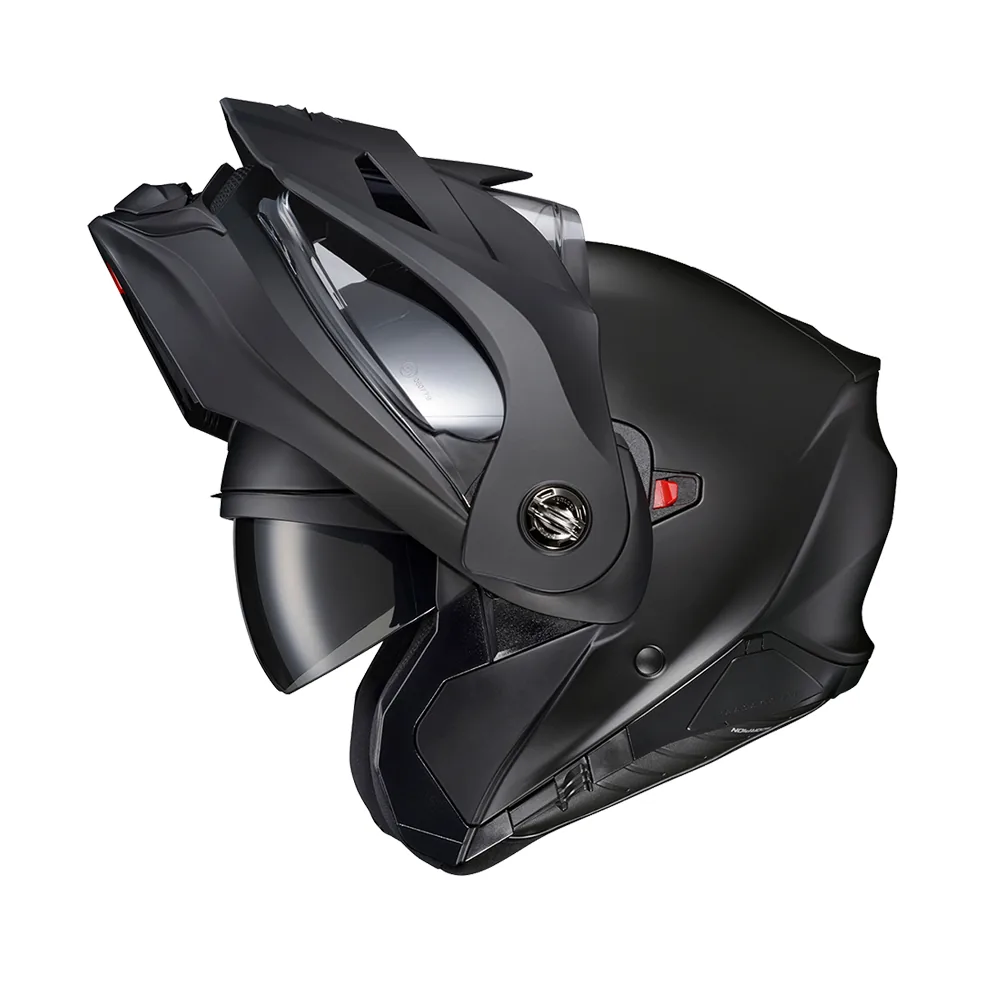
SHARP publishes a Scorpion brand index, and it’s the page to check before you trust any Scorpion star rating a search hands you. It says that “Scorpion currently has 25 helmet models independently tested by SHARP since 2007. Across the range, the average safety rating is 3.4 out of 5 stars”, and it answers the obvious follow-up itself: “The highest SHARP safety rating achieved by a Scorpion motorcycle helmet is 4 out of 5 stars.” Every one of those 25 entries is homologated to a UN ECE standard, and all but one carries a UK retail price, which is the tell that the whole index is European-market stock. None of these six helmets appears on it under its US name, and SHARP’s own summary of what it has measured leaves out the category two of them sit in: “Based on the helmets tested by SHARP, Scorpion produces full face, system (modular/flip-up) and non-protective lower faceguard type motorcycle helmets.” No adventure helmet, in other words, so neither the AT950 nor the AT960 carries a SHARP star. Jim Pruner said the same in his AT960 review: “Unfortunately, neither the AT950 (named the ADX-2 outside North America) nor the AT960 have been tested by SHARP yet”. That’s still true.
Two of those European helmets are close relatives of picks here, and they’re worth knowing about as long as you don’t read them as American results. SHARP’s model entry for the Exo R1 Evo reports that “The Scorpion Exo R1 Evo is a Full face type Motorcycle Helmet that received a 4 Star safety rating when tested by SHARP”, and records that helmet as ECE 22.06 on a double D-ring strap, which is the closest thing to a lab result the R1 family has. Its separate entry for the EXO1400 Air reports that “The Scorpion EXO1400 Air is a Full face type Motorcycle Helmet that received a 4 Star safety rating when tested by SHARP”, but that entry records the older ECE 22.05 standard and a fibreglass shell, where the US ST1400 Evo is sold as carbon. Our guide to the safest motorcycle helmets works through what the star scores actually mean.
One more thing to be careful with, because it’s on Scorpion’s own site. The company’s US history page claims that “every ScorpionEXO motorcycle helmet is ECE 22-06 certified”. That’s not what its own product pages say: the Covert X page lists DOT only, and the EXO-R430 page lists DOT plus Snell 2025 with no ECE line at all. Read the certification block on the helmet you’re buying, not the brand page.
How to choose between them
Head shape first, everything else second
Scorpion builds almost everything around an intermediate oval interior, which our helmet size calculator and head shape guide calls “the most common in the USA, UK, and Australia”. Bad news if your head is long or round: the wrong interior shape presses on the front and back, or on the sides, and sizing up never fixes it. The one variation comes from Pruner, who found that “The AT960 interior shape is on the narrow side of Intermediate Oval.”
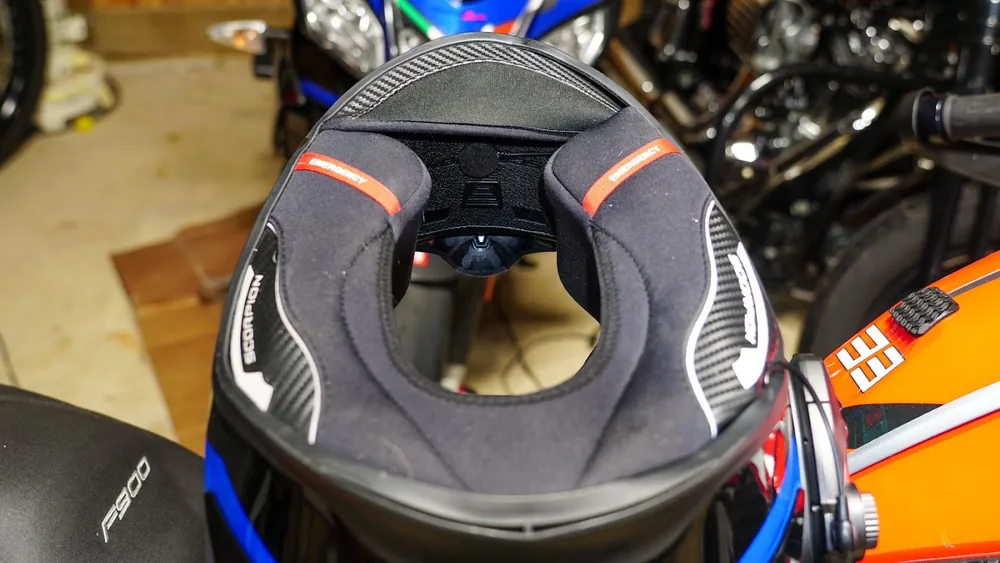
If you want a comm unit, buy the helmet and the unit together
Scorpion sells its own EXO-COM system and the generations are not interchangeable. The R430’s product page carries the note: “LINK-1/1C is not compatible with EXO-COM Gen 1 communication housings used in the EXO-GT930, EXO-AT960, and EXO-T520.” Those three take the Gen 1 kit; newer helmets take the LINK units. All of them have speaker pockets sized for a third-party intercom if you’d rather not buy into either.
Two models people keep searching for
The EXO-C110 half helmet is the awkward one. It is not among the thirty names in the model filter on Scorpion’s US site, and in the retailer feed I watch no C110 helmet turns up in the current listings at all: the only C110 part still carried is a replacement peak visor. That reads like a discontinued helmet still trickling through old stock. I can’t find a model Scorpion calls its replacement, so I’m not going to guess one up for you.
The EXO-AT950 is the AT960’s predecessor and it’s still in Scorpion’s model filter. Pruner’s account of what changed settles it: the AT960 “takes a positive step up in the protection department (from the DOT-only AT950) in the form of dual certification for DOT FMVSS 218 and the newly minted ECE 22.06 standard.” That’s not a difference worth saving on.
Scorpion helmet FAQs
Are Scorpion helmets good?
Solidly mid-table rather than exceptional, on the only independent measure the brand has. SHARP’s Scorpion index puts the brand average at 3.4 stars across the 25 European models it’s tested, and 4 stars is the best any Scorpion has managed. What Scorpion does well is put composite shells, inflatable cheek pads, internal sun visors and Pinlock-ready shields into brackets where rivals ship plastic.
How much do Scorpion helmets cost?
Street prices move constantly, and Scorpion runs closeouts on last year’s graphics. The EXO-R430 sits at the budget end, and everything else gets priced against it. The GT930 Transformer, AT960 and Covert X land in the middle, at roughly one and a half to two times that. The R1 Air and the carbon ST1400 Evo top the mainstream range at more than two and a half times the R430, and the carbon EXO-Warp prices above all of them.
Where are Scorpion helmets made?
Scorpion is Korean-owned and its helmets are made in Asia. The company’s own history page states that “ScorpionEXO is owned by KIDO SPORTS”, that the parent runs an R&D operation in Korea and a factory in China, and that its KIDO Sports VINA factory began production in Vietnam in 2021. The part that matters to a buyer is the last claim on that page: Scorpion says it moulds its own shells and builds its own liners in-house rather than badging helmets built by a contract manufacturer, which is not true of every brand at this price.
What head shape do Scorpion helmets fit?
Intermediate oval, across every helmet here that publishes a shape. RevZilla lists the R1 Air as Intermediate Oval, the J&P Cycles listing says the same for the ST1400 Evo, and two testers found it on their own heads: Jim Pruner on the AT960 and Jared Northcott on the Covert X. The only nuance is Pruner’s note that the AT960 sits “on the narrow side of Intermediate Oval”. Long-oval and round-oval heads are not well served by this brand.
Does Scorpion make a carbon fiber helmet?
Several. The ST1400 Evo is built on a “Resin-infused TCT-U 3K carbon fiber shell” per the J&P Cycles listing, and Scorpion’s US model filter also carries an XT9000 Carbon, an EXO-TECH II Carbon, a Covert FX Mod Carbon and a carbon R1 Air. The one to know about is the EXO-Warp, which prices above every other helmet here and is the reason the R1 Air isn’t the flagship any more: Scorpion’s page describes “Lite Force Carbon Matrix Shell Technology” and claims “Our Race model has earned triple certification FIM Racing #2, ECE 22.06 and DOT FMVSS No. 218.” Note that Scorpion scopes the FIM claim to its Race model, and that none of these carbon helmets has a published SHARP rating.
If you take one thing away: match the interior shape to your head, buy the helmet whose worst trait you can live with, and ignore any star rating that belongs to a helmet with a different strap on it.