
Best Sena Intercoms (2026): Which Model to Buy for Your Group
 Evan Rally
left for contents
Short on time? Get the 60S EVO. It’s Sena’s mesh flagship, it carries an IPX7 rating, and it can still drop back to Mesh 2.0 for buddies on older units. Kitting out a whole group on a budget? The Spider RT1 runs under $250, roughly half the price, and joins the same mesh.
Ever pulled into a gas station and found out half your group dropped off the intercom ten miles back? Or learned at the trailhead that your buddy’s Sena won’t talk to yours, even though it’s the same brand? Sena sells more intercoms than most riders can keep straight, and the model numbers won’t tell you which ones play nicely together.
I’ve run comms for groups of up to 15 riders on tours through Northern Thailand, and the first question is always the boring one: what’s everybody else running? Everyone in the group needs Sena mesh, and the oldest unit sets the mesh version, so check your group’s units before you buy. After that, Sena’s current mesh range sorts neatly by how you ride, and every model in it has a catch.
If you want to compare to Cardo, check out our best cardo intercoms article – I have much more personal experience with Cardos, having run everything from the Spirit to the Packtalk Pro as a solo rider, with a buddy and even on my Ride of Passage adventure tours.
Quick picks
- Best overall: 60S EVO. IPX7, Mesh 3.0 with a Mesh 2.0 fallback, under $500.
- Best budget mesh: Spider RT1. Under $250 and mesh only. No IP rating.
- Best low-profile pick: 50R. If you keep one helmet. No IP rating, but fine in heavy rain for Bennetts’ tester.
- Newest flagship: 60X. If you want a joystick and wireless charging at the EVO’s price.
- Slimmest pick: Spider X Slim. If a side-mounted brick bugs you. IPX7, mesh only.
- Best for wired audio: 50S. If you plug in earbuds. It cut out in heavy rain for Bennetts’ tester.
Best Overall 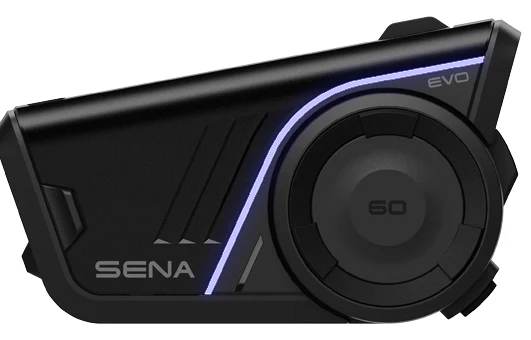
|
Best Budget Mesh 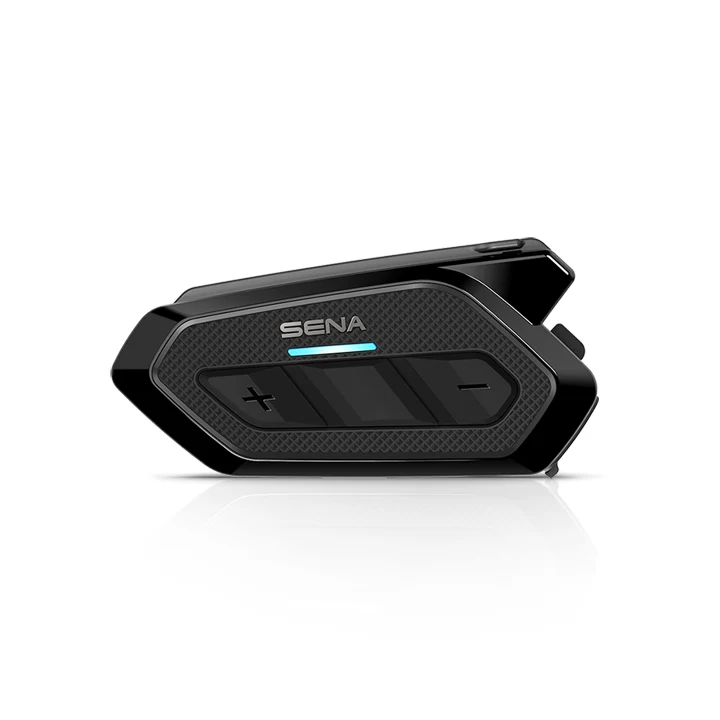
|
Best Low-Profile Pick 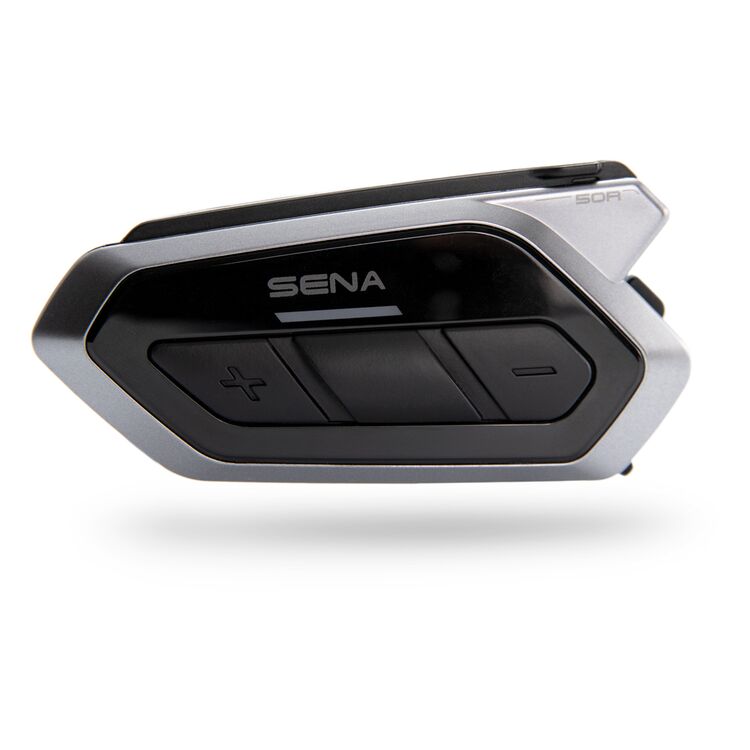
|
Sena's 60-series mesh flagship: Mesh 3.0 with a Mesh 2.0 fallback for older Sena units, Sound by Bose, an IPX7 rating and the 60S's magnetic mount. | Sena's mesh-only headset with a three-button control. It runs Mesh 3.0 open and group mesh, pairs with your phone for music, calls and GPS, and joins other Sena mesh units. | Low-profile intercom with Mesh 3.0 and Harman Kardon audio delivers rugged, seamless group comms and immersive music while on the move—built for adventure riders. |
|
|
|
|
|
|
Sena's 60-series mesh flagship: Mesh 3.0 with a Mesh 2.0 fallback for older Sena units, Sound by Bose, an IPX7 rating and the 60S's magnetic mount.
- IPX7 rating
- Falls back to Mesh 2.0 for riders on older Sena units
- Sena's limited lifetime warranty
- Two universal helmet clamps in the box
- Bulky: the same size as the original 60S
- The priciest pick here, tied with the 60X
Sena's mesh-only headset with a three-button control. It runs Mesh 3.0 open and group mesh, pairs with your phone for music, calls and GPS, and joins other Sena mesh units.
- Cheapest way into Sena mesh among the picks here
- Sena lists it as compatible with the 50S, 50R and 30K over mesh
- Low-profile hook-and-loop mount that WebBikeWorld found very secure
- Close to 2 km between two units over open terrain in WebBikeWorld's test
- No Bluetooth intercom, FM radio or voice commands
- No IP rating on Sena's spec sheet
Low-profile intercom with Mesh 3.0 and Harman Kardon audio delivers rugged, seamless group comms and immersive music while on the move—built for adventure riders.
- Rugged design resists rain and tracks well to your helmet
- Crisp HD Harman Kardon audio cuts wind noise at speed
- Mesh 3.0 auto‑routes signals for stable group connections
- Rapid USB-C charging delivers hours of use in minutes
- Hard‑wired speakers make swapping helmets a hassle
- Voice commands may have occasional choppiness at speed
The six side by side
| Model | Best for | Price (US) | Rain | Mesh talk time (Sena) | Music battery (Bennetts) |
|---|---|---|---|---|---|
| 60S EVO | Most riders | Under $500 | IPX7 | 19 h | 12.5 h (original 60S) |
| Spider RT1 | Groups on a budget | Under $250 | No IP rating | 12 or 20 h (Sena prints both) | Not tested |
| 50R | One helmet | Under $400 | No IP rating; fine in heavy rain (Bennetts) | 11 h | 9 h 50 min |
| 60X | Gadget fans | Under $500 | IPX7 | 19 h | Not tested |
| Spider X Slim | Smallest unit | $250 to $350 | IPX7 | 11 h | Not tested |
| 50S | Wired audio | Under $400 | No IP rating; cut out in heavy rain (Bennetts) | 13 h | 9 h 40 min |
The 50 series doesn’t save you much over the 60S EVO, and only the three newest units carry an IP rating. If you ride in the wet, the rating matters more than the price gap.
Sena 60S EVO: best overall
Buy it if: you ride with other Senas, you ride in the rain, or you own two helmets.
Sena's 60-series mesh flagship: Mesh 3.0 with a Mesh 2.0 fallback for older Sena units, Sound by Bose, an IPX7 rating and the 60S's magnetic mount.
- IPX7 rating
- Falls back to Mesh 2.0 for riders on older Sena units
- Sena's limited lifetime warranty
- Two universal helmet clamps in the box
- Bulky: the same size as the original 60S
- The priciest pick here, tied with the 60X
The 60S EVO is the one to buy if you want a Sena and never want to think about it again. It keeps the original 60S’s size (Sena lists both at 94 x 52 x 27 mm and 68 g) and changes what’s inside: Sound by Bose instead of Harman Kardon, a claimed 27 hours of Bluetooth intercom and 19 of mesh where the 60S claims 24 and 17, and a limited lifetime warranty where the 60S page says three years.
Why it’s my pick: IPX7, which Sena says means it keeps working fully submerged, and a spec sheet that lists both Mesh 3.0 and Mesh 2.0. I ride through Bangkok’s monsoon season, and “water resistant” doesn’t mean much at highway speed in a downpour. The Mesh 2.0 fallback is what lets you ride with a friend whose 50S never got updated. You also get the 60S’s magnetic mount, plus what Sena calls “two sets of universal helmet clamps” in the box. Milbank greeted the 60S’s update method with “Another ‘at last'”: it “can be updated over the air via your smartphone app without having to plug it into a computer or use a clunky WiFi charging adaptor.”
On the original 60S, the same size unit with the older audio and battery, Bennetts BikeSocial’s John Milbank and Ultimate Motorcycling’s Jonathan Handler reported:
- Calls at speed: Milbank, on a Schuberth S3: “my wife couldn’t tell I was riding the bike at 70mph while talking to her.”
- Battery: streaming music at full volume, the unit “lasted approximately 12.5 hours, which is an impressive result compared to some of the competition.”
- Rain: Milbank called it “a properly water-resistant intercom” and wrote that “I blasted it with the hose and had no problems”.
- Sound: Handler’s summary after several months was “Great fidelity with my music, clear communication with riding buddies, and ease of use”.
Milbank’s verdict was that the 60S “is a very impressive motorcycle intercom that I won’t hesitate to recommend.” If you’re weighing it against Cardo’s flagship, our Cardo Packtalk Pro vs Sena 60S comparison covers that fight, and there’s more on the original in our Sena 60S write-up.
The catch? It’s big, and it’s the priciest of the six, tied with the 60X. Milbank listed “A little bulky” among the 60S’s cons and found the flashlight is “really not very bright at all”. Milbank also complained that one of the original’s two clamps had a fixed boom mic, so “unless your second helmet is an open-face, you’re paying for a second mount that you won’t really need.” Sena describes both EVO clamps as universal, but you’re still paying for a second kit you may never fit.
Sena Spider RT1: best budget mesh
Buy it if: you’re kitting out a group where everyone will be on Sena mesh, and nobody needs to talk to a Cardo.
Sena's mesh-only headset with a three-button control. It runs Mesh 3.0 open and group mesh, pairs with your phone for music, calls and GPS, and joins other Sena mesh units.
- Cheapest way into Sena mesh among the picks here
- Sena lists it as compatible with the 50S, 50R and 30K over mesh
- Low-profile hook-and-loop mount that WebBikeWorld found very secure
- Close to 2 km between two units over open terrain in WebBikeWorld's test
- No Bluetooth intercom, FM radio or voice commands
- No IP rating on Sena's spec sheet
The Spider RT1 is mesh and nothing else, and that’s the point. Cole’s WebBikeWorld review lists what it leaves out: Bluetooth intercom, FM radio and voice commands. It still pairs with your phone for music, calls and GPS, and Sena says it works with every Sena mesh unit, naming the 50S, 50R and 30K among them.
At under $250, it’s the cheapest way into Sena mesh of the six, and when you’re buying four or eight units for a riding club, the per-unit price is the whole conversation. Cole called the RT1 and its jog-wheel sibling, the ST1, “economical entry-points with excellent performance” when they were new. Milbank, mentioning it in the 50R review, said it “could be a good solution for large groups of riders looking to link up with each other.”
- Range: Cole reports that with two Spiders over open terrain, “ranges of close to or possibly a wee bit beyond 2km have been noted without any significant audio degradation.”
- Mount: the RT1 sticks on with hook-and-loop pads, and Cole wrote, “Once mounted, this is a very secure option and there are no concerns about the module staying in place”.
- Battery: with the mesh in steady use plus calls and some music, Cole found it still covers “a couple of half-day rides before needing recharging, so a full day of riding should not be an issue.”
Don’t lean on Sena’s talk-time number. Its RT1 page says “an impressive 12 hour talk time” in the overview and “up to 20 hours” in the spec list.
The catch?
- No Bluetooth intercom. It can’t talk directly to a pillion’s Bluetooth-only headset or a buddy’s Cardo. It’s Sena mesh, or Sena’s Wave app over phone data.
- No IP rating on its spec sheet. Cole: “Something (still) missing from Sena systems, including these newest releases, is an elemental build standard (IP Code)”.
- Heavy gloves: “The Jog-Wheel-equipped ST1 is still easier to use while wearing heavy gloves, though.” The ST1 is the RT1’s jog-wheel twin, so it’s the Spider to get if you ride in winter gauntlets.
Not Sure What Size to Order? Get Our Gear Fit Guide.
Sizing charts for helmets, jackets, gloves & boots — with brand-specific fit notes and pro tips so your gear fits right the first time.
- Helmet sizing by brand
- Jacket, glove & boot charts
- Head shape guide
- Between-sizes tips
Sena 50R: best low-profile pick
Buy it if: you keep one helmet, you want a slim hard-wired unit that stays put, and you find a good deal on it.
Low-profile intercom with Mesh 3.0 and Harman Kardon audio delivers rugged, seamless group comms and immersive music while on the move—built for adventure riders.
- Rugged design resists rain and tracks well to your helmet
- Crisp HD Harman Kardon audio cuts wind noise at speed
- Mesh 3.0 auto‑routes signals for stable group connections
- Rapid USB-C charging delivers hours of use in minutes
- Hard‑wired speakers make swapping helmets a hassle
- Voice commands may have occasional choppiness at speed
The 50R is the 50S with the bulky bracket thrown away. It sticks or clamps straight to the shell, with the speaker and mic wiring hard-wired into its base. On the 50S, Milbank suspected the water was getting in at “the connections between the bracket and the unit”.
That’s the reason to buy one. Milbank’s 2022 Bennetts review says the 50R “doesn’t have an IPX waterproof rating, but it is absolutely fine in even heavy rain”. Writing when the 50 series was Sena’s top line, Milbank concluded that “those looking for a top-of-the-range Sena would, in my opinion, be best with this 50R over the 50S thanks to its waterproof design, and the more compact fitting to the side of the lid.” Sena’s own pitch leans on the 2020 BMW GS Trophy, where it says the 50R was “Tested and proven by over 100 competitors and staff across the wilds of New Zealand”.
Milbank also put the 50R through battery and range runs:
- Battery: streaming music at full volume, it “achieved 9 hours and 50 minutes, which is in line with the 50S.” Sena’s current spec sheet claims up to 13 hours of Bluetooth intercom and 11 of mesh.
- Range: on Milbank’s straight test road, “the 50R lost connection at just over 800m” on Bluetooth, and mesh ran about 20% shorter rider to rider.
- In a group: with one 50R and two 50S units on a country road, “each rider could have about 400m between them for a strong signal across all three.”
The 50 series launched on Mesh 2.0, and Handler at Ultimate Motorcycling reports that “Mesh 3.0 has been rolled out to 50S and 50R models” through firmware. Update yours before a group ride with 60-series riders.
The catch? In Milbank’s words, “once you’ve fitted the Sena 50R, it’s meant to stay there.” You charge it on the helmet, and “it won’t charge while it’s running.” Bruce Cole at WebBikeWorld found the three-button layout “easy to use but it is often not as ‘glove-friendly'” as the 50S jog dial in medium to heavy gloves. And it isn’t much cheaper than the 60S EVO, which carries the IPX7 rating the 50R lacks. The full head-to-head is in our 50S vs 50R breakdown.
Sena 60X: newest flagship
Buy it if: you want wireless charging and a joystick, and you’d rather have the newest hardware than a unit the size of the original 60S.
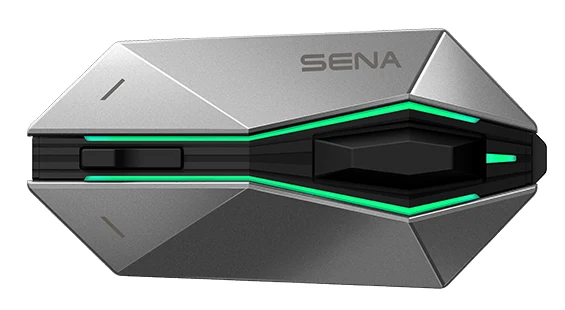
Sena's joystick-controlled 60-series flagship with Mesh 3.0 and 2.0, Bluetooth and Wave intercom, Sound by Bose, Qi wireless charging and an IPX7 rating.
- Joystick control and remappable custom buttons
- Charges on Qi-certified wireless pads or USB-C
- IPX7 rating and Sena's limited lifetime warranty
- Two clamp kits in the box
- First-generation joystick and mount design
- Same price bracket as the 60S EVO
The 60X is Sena’s other flagship, the one Sena calls “Sena’s first headset with a joystick control”. It adds remappable custom buttons, Qi wireless charging alongside USB-C, automatic power on and off, and a redesigned horizontal magnetic mount.
60X or 60S EVO? Sena’s spec sheets give both Mesh 3.0 and 2.0, Sound by Bose, AI noise cancellation, IPX7, two clamp kits and the limited lifetime warranty, and they cost about the same. The tiebreaker is the hardware you touch:
- Get the 60X for wireless charging, the joystick and remappable buttons, or a smaller unit: 89 x 44 x 26 mm and 58 g against the EVO’s 94 x 52 x 27 mm and 68 g.
- Get the 60S EVO for the flashlight, which the 60X page doesn’t list, or for a unit the same size as the original 60S that Milbank and Handler rode with.
- Riding with 60S owners? Either one fits in. Both list Mesh 3.0 and 2.0.
The catch? It’s the newest hardware of the six, with a new control layout and a new mount, where the EVO keeps the 60S’s dimensions and magnetic mount. If a Cardo is the other option on your list, our best Cardo intercoms roundup sorts that side of the fence.
Sena Spider X Slim: slimmest pick
Buy it if: you ride a sport or naked bike where wind on a side-mounted unit bugs you, and your group is all on Sena mesh.
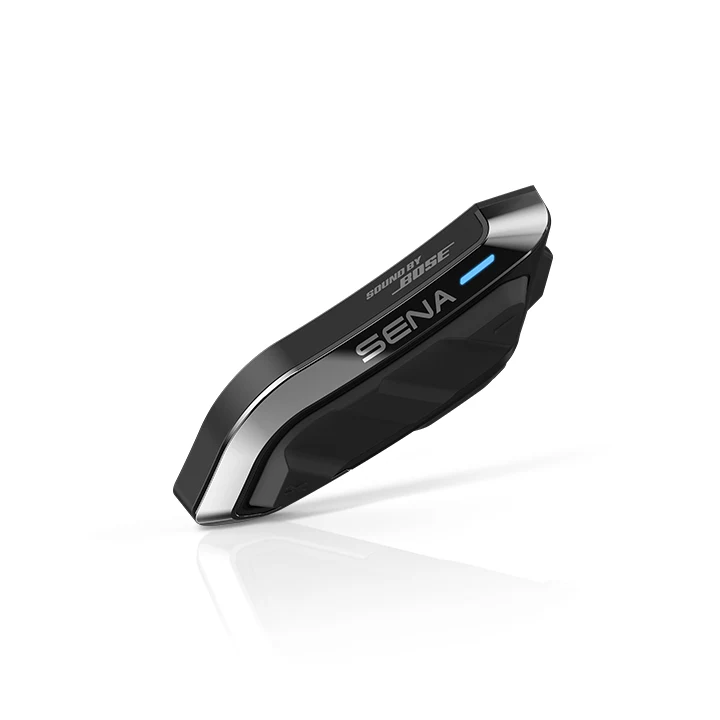
Sena's small mesh-only unit: a 74.5 x 31 x 16 mm, 23.2 g main module running off a separate battery pack, with Mesh 3.0 and 2.0, Wave, Sound by Bose and IPX7.
- The smallest main unit among the picks here
- IPX7 rating and Sena's limited lifetime warranty
- Mesh 3.0 and 2.0 plus Wave intercom
- Sena claims 11 hours of mesh talk time and 1.6 km range
- No Bluetooth intercom
The Spider X Slim is for riders who hate a brick on the side of the helmet. Sena lists the main unit at 74.5 x 31 x 16 mm and 23.2 g, and it runs off a separate battery pack with its own holder. Sena lists the 60X at 26 mm thick and the 60S EVO, 50R, 50S and Spider RT1 at 27 mm.
Milbank closed the 60S review wishing for “a pared-down device that has the same comms tech as the 60S but without the flagship’s trimmings”. On Sena’s spec sheet, the X Slim comes close to that wish, minus the Bluetooth intercom: Mesh 3.0 and 2.0, Wave, Sound by Bose, AI noise cancellation, FM radio, IPX7 and the limited lifetime warranty, a step above the RT1 on price.
The catch? Sena claims 11 hours of mesh talk time, the same as the 50R and well short of the 60 series’ 19, and 1.6 km of mesh range against 2 km for the other five. Like the RT1, it has no Bluetooth intercom, and the battery pack is one more thing to stick inside your lid.
Sena 50S: best for wired audio
Buy it if: you plug in earbuds or a wired audio device, you ride mostly in dry weather, and you find it discounted.
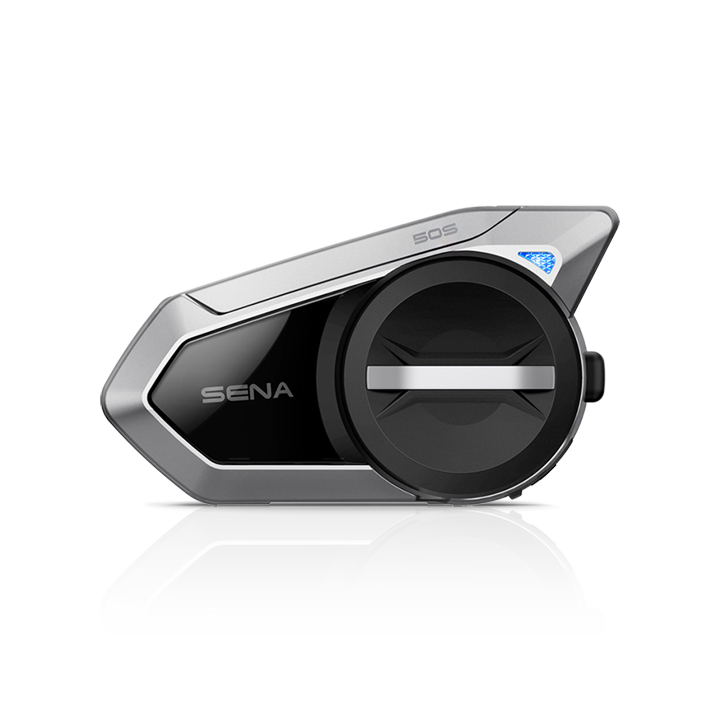
Premium Bluetooth intercom with Harman Kardon speakers and Mesh 2.0 tech for crystal-clear group communication and top-tier audio quality.
- Excellent sound quality (Harman Kardon)
- Long-range Mesh 2.0 intercom
- Easy-to-use jog dial
- Expensive
- Setup can be tricky
- Shorter battery life on Mesh mode
The 50S was Sena’s flagship before the 60 series, and it’s still sold. Buy it for the big jog dial and the mount: Milbank’s 2020 Bennetts review notes the bracket carries “a 2.5mm auxiliary input for MP3 players or anything else” and “a 3.5mm headphone socket to use your own earbuds”.
Range was its standout. “Compared to its main rival, the range of the Sena 50S is excellent,” Milbank wrote, measuring 1,230 m on Bluetooth and 1,080 m on mesh down a straight road with no traffic. The clamp is fiddly, with two small Allen set-screws, but “once on it’s a very secure mount, so it’s worth the extra five minutes of fiddling.” Firmware updates run through Sena’s WiFi charging cable rather than the phone app; Sena says the cable “detects and installs updates after a one-time setup”. Like the 50R, it can now run Mesh 3.0 after a firmware update, per Handler.
The catch?
- Rain: no IP rating on Sena’s spec sheet, and Milbank found that “in heavy rain at speed, water can stop it working.” The test unit shut itself down once and “booted straight back up without issue.”
- Battery: nine hours and 40 minutes of music, which Milbank called “okay, but not the best”.
- Voice control: Milbank got “Hey Sena, stop music” to work with “perhaps a 30% success rate”.
It also costs about the same as the 50R, which Milbank preferred. If you’re coming from an older Sena, our Sena 50S vs 30K comparison covers the jump, and the Packtalk Edge vs Sena 50S matchup covers its main Cardo rival.
How to pick the right Sena
Mesh 3.0 vs Mesh 2.0: check your group first
This is the one that ruins group rides. Handler’s 60S review for Ultimate Motorcycling warns that “Mesh 3.0 does not talk to 2.0, so you must run the 60S in 2.0 to connect with older units.” And the whole group follows the slowest unit: “If Mesh 2.0 is all one of the other units can use, you’ll all have to go with Mesh 2.0.” Milbank adds that “If one of your riding group hasn’t updated their device, you can switch back to Mesh 2.0 in the app.”

| Model | Mesh it runs | Other brands via |
|---|---|---|
| 60S EVO | 3.0, or 2.0 for older units | Bluetooth intercom, Wave |
| 60X | 3.0, or 2.0 for older units | Bluetooth intercom, Wave |
| Spider X Slim | 3.0, or 2.0 for older units | Wave only |
| 50R | 3.0 after a firmware update | Bluetooth intercom, Wave |
| 50S | 3.0 after a firmware update | Bluetooth intercom, Wave |
| Spider RT1 | 3.0; Sena lists the 50S, 50R and 30K as compatible | Wave only |
Before a group trip:
- Ask everyone which Sena model they run, and who’s on something older than a 50S.
- Have everyone update firmware the week before, not at the first gas stop.
- If one unit can’t get to Mesh 3.0, switch the 60-series units to 2.0. Handler says that works “only after switching to 2.0 in the Sena Motorcycle app and rebooting the unit”.
- Do a parking-lot check with everyone in their helmets before you roll out.
Riding with Cardo owners
Sena mesh only talks to Sena mesh. Milbank’s line is “Mesh is NOT cross-brand compatible”, but you’ve got two workarounds:
- Universal Bluetooth pairing: Milbank paired a 60S to a Cardo Packtalk Edge this way and got a good connection. That covers a pillion or one buddy, and Milbank also describes bridging a Bluetooth rider into a Sena mesh group.
- Wave: Sena’s app runs intercom over your phone’s data with any brand of headset. Milbank “connected to a friend more than 20 miles away and had a pretty clear conversation with them.” After a call of about 15 minutes, the Glasswire app showed “Wave had used 5.84MB of data”. You both need a signal.
The mesh-only Spiders have no Bluetooth intercom, so Wave is their route to a Cardo. Our guide to pairing Cardo and Sena walks through the button presses, and if you haven’t picked a brand yet, start with Cardo vs Sena.
Waterproofing splits the range in two
The 60S EVO, 60X and Spider X Slim spec sheets list IPX7. The 50S, 50R and Spider RT1 spec sheets list no IP rating. In Milbank’s testing the 50R held up in heavy rain and the 50S didn’t, so the bracket matters as much as the badge.
Range and battery: plan on less than the box says
All six claim 2 km in open terrain except the X Slim, which claims 1.6 km. Milbank’s experience across brands is that “intercoms never achieve their claimed figures”. On his straight test road, the 50S held 1,230 m on Bluetooth and 1,080 m on mesh, and the 50R lost Bluetooth at just over 800 m. Cole got close to 2 km between two Spiders over open terrain. Handler hit “some of the same intercom dropouts typical of all motorcycle helmet communications units at extreme ranges or around canyon walls.” Mesh stretches a group because the signal bounces off each unit, so the back of the pack can be much farther from the front than any one pair. There’s more on why in our helmet headset range explainer.
On battery, Milbank streams music at full volume until the unit dies. In separate reviews, the original 60S lasted about 12.5 hours and the 50R and 50S just under ten. Sena rates the 60S EVO above the 60S, at 19 hours of mesh talk time against 17.
Do you even need mesh?
If it’s just you, or you and a pillion, probably not. Milbank’s advice is that if you only want music, nav and a chat with a pillion or one riding buddy, “you can save a significant amount of money and still have exceptional audio quality.” Our budget motorcycle intercom picks include Sena’s Bluetooth-only 3S PLUS, and the full motorcycle Bluetooth headset guide puts Sena up against Cardo and the rest. Sena also builds its comms into its own helmets, like the Stryker, the Phantom and the Outrush 2 Mesh, and our Sena helmet guide covers those.
FAQ
What is the best Sena Bluetooth intercom?
For most riders, the 60S EVO: IPX7, Mesh 3.0 with a Mesh 2.0 fallback, and 19 hours of claimed mesh talk time. For a group on a budget, the Spider RT1.
Sena 50S vs 50R: which is better?
The 50R if you ride in the rain or want a slimmer fit; Milbank picked it over the 50S for its “waterproof design, and the more compact fitting to the side of the lid.” The 50S if you want the jog dial and the headphone and aux ports on its bracket.
Is the 60S worth it over the 50S?
If you ride in the wet, yes. Sena lists IPX7 for the 60S and no IP rating for the 50S, and the 60S updates through the phone app where the 50S uses Sena’s WiFi charging cable. In two separate Bennetts reviews, the original 60S ran about 12.5 hours of music and the 50S nine hours and 40 minutes.
Is Sena compatible with Cardo?
Not over mesh. Senas with Bluetooth intercom can pair one-to-one with a Cardo through universal pairing, and Sena’s Wave app connects any brand over phone data.
Will a new Sena work with my old 30K?
Over mesh, once its firmware is current. Sena’s Spider RT1 page names the 30K among the mesh units it works with, and Cole reported that the 30K got Mesh 2.0 through a firmware update. If yours is still on Mesh 2.0, a 60-series unit has to drop to 2.0 to join it, and so does everyone else in the group.
Pick the one that matches your group, update everyone’s firmware, and go ride.